1. Start
  2. /
  3. Resources
  4. /
  5. Proper archive facilities

Checklist

What makes a good archive facility

A professional archive is a safe and stable environment that protects and preserves valuable information over time. Here is a brief checklist of requirements that a good archive facility should meet. Consider it as a first guide; we are happy to provide more input. (The list is based on the recommendations from the Swedish National Archives.)

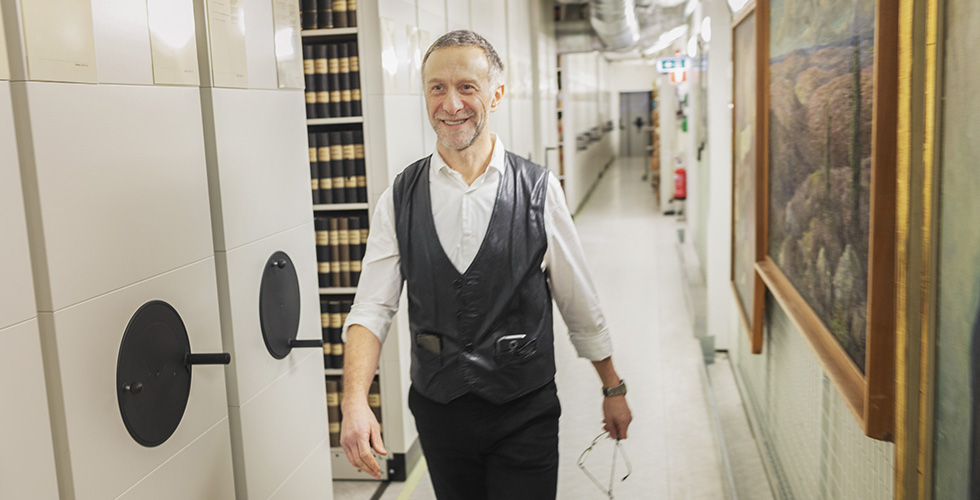
Foto: Alexander Ruas.

The Room

Here is a checklist for any archive storage that preserves historical documents and objects:

  • Temperature: A stable temperature of 18°C, with fluctuations of max ± 2°C. (The temperature can be higher or lower, the important thing is that it is stable with minimal variations.)
  • Humidity: A stable relative humidity (RH) of 30–40% (according to Swedish standards, a range of 30–50% is often recommended depending on material, but stability is key).
  • Warning system: Alarm system/monitoring for changes in both humidity and temperature must be in place.
  • Water: No active water pipes or drains are allowed inside the archive room. (This includes water sprinklers intended for fire fighting.)
  • Fire protection: The room must consist of one or more fire compartments. An example of a fire compartment is a room with closable doors, where the doors have a fire resistance rating of EI 120 (120 minutes). This can be achieved with doors rated for 120 minutes or through an airlock with two separate doors each rated for 60 minutes. In case of fire alarm, the doors should preferably close automatically.
  • Electricity: No electrical panels or fuse boxes may be placed inside the room. An external main switch to cut all power is required.

Work Processes and Handling

Historical material often arrives in disorder and is difficult to retrieve. A fundamental task for archivists is therefore to cull, organize, and catalog the material. This work is facilitated by:

  • Dedicated receiving room: All incoming material arrives at a dedicated receiving area (ingest), where it is organized and cataloged before being transferred into the actual archive repository.
  • Shelving system: Use compact shelving (also called rolling shelves) in the archive repository to optimize space. The shelves should be on a plinth (raised from the floor) to protect against potential flooding.
  • Materials: Use acid-free archive boxes made of durable, aging-resistant material.
  • Bulky materials: Implement solutions for bulky items and documents, such as map cabinets for large drawings or specially adapted boxes for textiles.

Access control

Clear and simply guidelines are also required for who gets access to the archive and how this access is granted:

  • Perimeter security: Ensure that systems are in place to control who has access to the archive.
  • Authorization process: A clear process for authorization must be established to define who is allowed to be in the archive and under what conditions.

This website uses cookies

Cookies consist of small text files. They contain data that is stored on your device. To enable us to place certain types of cookies we need to obtain your consent. At , corp. ID no. , we use the following kinds of cookies. To read more about which cookies we use and storage times, click here to access our cookies policy.

Manage your cookie-settings

Necessary cookies

Check to consent to the use of Necessary cookies
Necessary cookies are cookies that must be placed for basic functions to work on the website. Basic functions are, for example, cookies which are needed so that you can use menus on the website and navigate on the site.

Functional cookies

Check to consent to the use of Functional cookies
Functional cookies need to be placed on the website in order for it to perform as you would expect. For example, so that it recognizes which language you prefer, whether or not you are logged in, to keep the website secure, remember login details or to be able to sort products on the website according to your preferences.

Cookies for statistics

Check to consent to the use of Cookies for statistics
For us to measure your interactions with the website, we place cookies in order to keep statistics. These cookies anonymize personal data.

Personalization cookies

Check to consent to the use of Personalization cookies
In order to provide a better experiance we place cookies for your preferances

Cookies for ad-tracking

Check to consent to the use of Cookies for ad-tracking
To enable us to offer better service and experience, we place cookies so that we can provide relevant advertising. Another aim of this processing is to enable us to promote products or services, provide customized offers or provide recommendations based on what you have purchased in the past.

Ad measurement user cookies

Check to consent to the use of Ad measurement user cookies
In order to show relevant ads we place cookies to tailor ads for you

Personalized ads cookies

Check to consent to the use of Personalized ads cookies
To show relevant and personal ads we place cookies to provide unique offers that are tailored to your user data