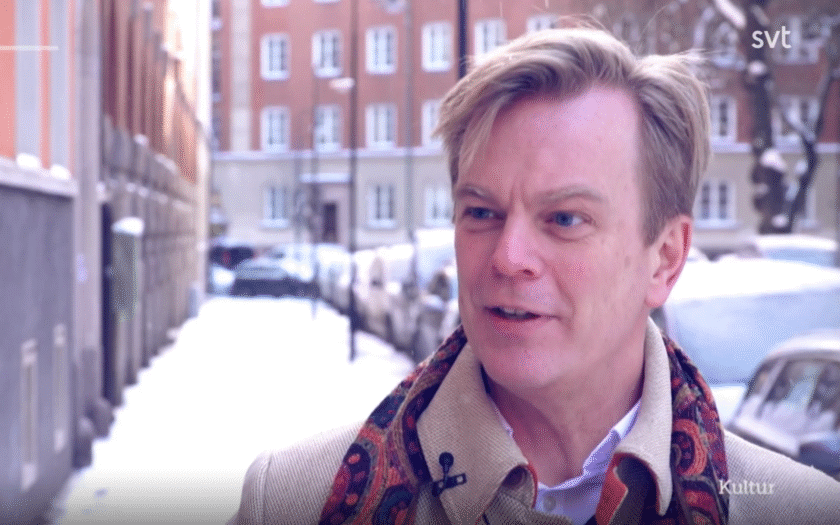
Our communications manager Anders Sjöman was recently interviewed by SVT Kulturnyheterna about the digital alternatives for cultural industries during the pandemic. So we asked him to elaborate on his thoughts even more.
It started with an interview on SVT Kulturnyheterna…
On February 9, SVT Kulturnyheterna featured a segment where they noted that many cultural events that shifted from analog to digital due to the pandemic restrictions have had unexpectedly good online audience numbers. The Gothenburg Film Festival had 300,000 digital visitors in 2021, compared to 145,000 physical attendees in 2020; the dance band week in Malung had 160,000 digital visitors in 2020 (44,000 physical in 2019); and Dramaten had 375,000 digital visitors in 2020 (237,000 physical in 2019).
Has the pandemic forced the cultural sector in a direction that is better, wondered SVT Kulturnyheterna's Kim Veerabuthroo Nordberg.
"Maybe not better, but it has given the cultural industries more options to play with when looking for revenue," said Anders Sjöman, interviewed in the segment. "Options they might not have dared to try if the restrictions hadn’t forced them to test."
Is it good?
"I think so. The more ways you can make money from your cultural industry, the better," Anders said and later continued in the segment: "Imagine if there is even more money to be made in this new world for cultural industries. They have the physical experience, as usual, but now also the digital one, which after a year they now know how it works. They can charge for the physical experience and the digital one. Imagine if they have left money on the table all these years!"
Watch the segment here (available until Tue Feb 16, 2021)
What were you thinking now, Anders Sjöman?
The segment made us at the Centrum för Näringslivshistoria think more about the historical development of cultural industries, especially during technological shifts. We asked Anders to expand on his thoughts a bit more.
How new is what you discussed in the segment, really?
In a way, it’s not that new. Cultural industries have always had to adapt when new technology has come and disrupted the revenue streams they relied on until then. But it usually works out. Live music didn’t disappear when the gramophone and radio came, which many feared at the start of the 20th century. Radio didn’t die when TV came, it just found a different role and new revenue streams. People talked about “cinema death” when TV arrived, but we still have cinemas. For several years now, digitalization has been something everyone, including the cultural sectors, have had to relate to, with streaming music and video as pioneering new solutions. This development was underway even before the pandemic.
What the pandemic did, which might be more new historically, is speed up this development. Suddenly the audience disappeared completely from the physical space. To so abruptly not find your audience where you are used to having it—I understand this gave many cultural industries near-death experiences. But at the same time, it wasn’t the audience’s interest that disappeared, so there was still something to build on. And cultural industries have now in various ways over a year tried to find digital solutions instead. And this, that after a technological shift they seek out new ways to reach their audience, is something familiar from history.
Is there perhaps even an upside to everything they’ve been forced to do this past year?
The upside might be that they have been forced to test on a larger scale than normal. If the old revenue model had still worked reasonably well, they wouldn’t have tested as extensively as they did now. History is full of examples of industries and companies who delayed adapting to technological shifts and were eventually overtaken, from Facit to Kodak and Blockbuster.
I believe, for example, that we wouldn’t have seen fully digital film festivals for many years if the pandemic hadn’t forced them there. Museums have expanded their online exhibitions and hold talks online. Operas and theaters already streamed online before, but now for a time it’s all they can do. This has led to people from all over the world suddenly taking part in a discussion about, for example, the mistresses of British monarchs through history, like the British Historic Royal Palaces held a few days ago.
I really don’t think festivals, museums, and operas will stop their physical activities, but now they have had a whole year to try digital complements and learn from it. They might not have dared to do that otherwise.
Are there more such examples?
A personal favorite example is the British pop band Mamas Gun. They usually tour around the world but now are confined to their homes in different parts of southwest England. And they have managed to solve the technical challenges so that they now perform live concerts online – from their respective basements. I’m a fan but have never managed to see them live. Now suddenly I can see them live in my living room on a Friday night. And when they ask for contributions through online payments, I of course give. Much cheaper than the concert tickets I would otherwise have paid for. A concert ticket that I will gladly pay for again when they start touring again.
So digital is the new thing for cultural sectors?
Yes, but not alone. History shows that new technology never completely replaces the old; they learn to coexist. Physical schools haven’t ended because we got digital education. We have education that blends digital and physical meetings, or “blended learning” as I’ve heard educators call it. E-books didn’t kill the physical book; they coexist. Also with audiobooks. So I believe in interplay between the forms – and those who learn to use the interplay are those who will make money.
Shall we guess there will be new business models from this?
Maybe not entirely new models. Historically, there are only three sources of revenue, I would say: you can sell, rent out, or seek third-party financing, with advertising as the clearest example. That won’t change. But cultural industries might start mixing more what they offer. Now a theater knows that their audience is both in the auditorium and online. So they can start charging for both experiences. Probably more for the physical place than for the web broadcast of the same play. But they charge – because now they know the audience is there in front of screens after this test year that the pandemic caused. And that is revenue they never got before.
Now I’m obviously speaking from pure cost-and-revenue analysis. There are good artistic arguments for not wanting to stream your theater performance online, such as theater being created in the enclosed room in the meeting with the specific audience present at that time, making each performance unique. But now at least you have the possibility to consider streaming – which you can charge for.
Can all cultural industries go digital?
Most. But maybe not all. I don’t see how the pure visitor industry can get around this. How can, for example, fairs and amusement parks offer digital solutions? Gröna Lund online, a digital Liseberg? That experience, I think, is hard to find a digital meeting place to match. Maybe a big combination of virtual worlds, 3D scans, network games, and augmented reality? But I actually don’t think the pandemic has pushed the audience there yet. But maybe I am just shortsighted here, a more open-minded cultural entrepreneur might have an idea how to do it…
For some events very tied to the physical space, alternatives have been found, and they are not necessarily digital. I’m mostly thinking of sports events, such as Vasaloppet that changed their summer week to “Hemmavasan” where you could participate from wherever you were. It will be interesting to see if they continue this even when the pandemic ends.
Just one thing: you say cultural industries all the time, whereas others might say cultural activities?
Yep. Culture obviously has a value that goes far beyond the economic and financial, or whatever numerical metrics you want to use. But at the same time, cultural practitioners always have to consider how their culture is financed. So since I always think from a business perspective, I insist on talking about cultural industries.
//