1. Start
  2. /
  3. Infrastructure Sources: Historical Archives as a Resource for Robust and Sustainable Transport Facilities

Project

Infrastructure Sources: Historical Archives as a Resource for Robust and Sustainable Transport Facilities

This research project, led by our research secretariat, is funded R&D funds at the The Swedish Transport Administration (Trafikverket) and carried out in collaboration between the Centre for Business History (CfN) and the National Museums of Marine, Transport and Military History (SMMTF).

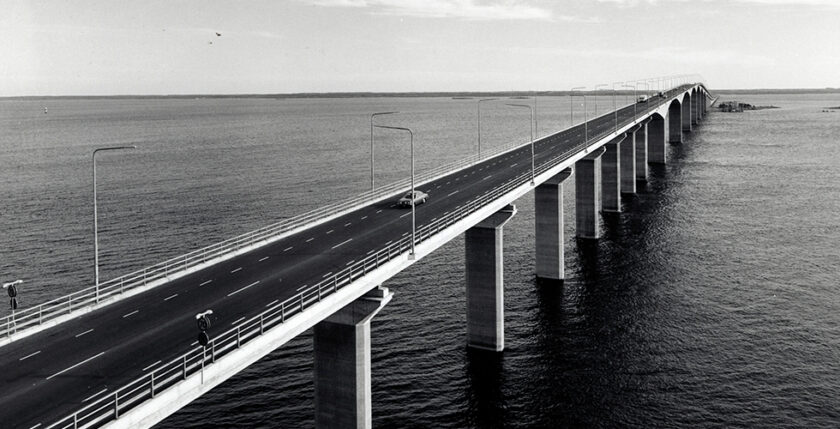
The Bridge to Öland, in 1972. Photo: Gösta Nordin, from Skanskas historical archive at the Centre for Business History.

Purpose

This three-year research project aims to develop and analyze methods for making transport and infrastructure historical sources accessible and usable, both for Trafikverket (The Swedish Transport Administration) and for transport history researchers. The project also aims to create tools for harnessing and utilizing the accumulated knowledge and experience among Trafikverket's employees and among consultants.

The project investigates the following research questions:

  • How can historical knowledge and source material be used in project design and maintenance within Trafikverket?
  • How can historical sources contribute to more well-founded decisions and measures within Trafikverket?
  • How can increased access to historical sources contribute to more multifaceted research within the field of transport history?

To achieve this, we want to investigate and apply digital methods to:

  • Connect different source materials.
  • Increase searchability and facilitate availability.
  • Link the historical source material to geographic locations, historical infrastructure measures, and relevant user groups.

Background

The feasibility study ”Historical materials useful for infrastructure and research” (TRV 2021/53219) conducted an overview of transport historical research and transport historical collections in Sweden. The project group also interviewed relevant stakeholders within Trafikverket, including consultants, memory institutions, and researchers, and carried out targeted pilot efforts regarding the organization and cataloging of archives and digitization of documents, historical photography, and film from the construction and maintenance of transport facilities.

The feasibility study shows that the need for improved overview and accessibility concerning historical material is very great within all these sectors. It also shows that there are significant historical sources useful for planning and management of infrastructure, but since they are largely unorganized and difficult to access, their resource potential often remains unused.

This project is based on the experiences of the feasibility study and seeks solutions to the problems it identified. It makes use of the knowledge compilations and method tests conducted then to achieve deepening and utilize the historical sources of the infrastructure.

Case Studies

The project applies a case study methodology based on locations and sections where future infrastructural measures are planned – often nodes, transshipment points, border zones, risk sites/problem areas.

Case Study 1: The Freight Corridor through Skåne

The freight corridor through Skåne runs from Trelleborg to Ängelholm. Within this project, the section Arlöv–Ängelholm is studied, particularly the Lomma line between Arlöv and Kävlinge. The section opened for passenger traffic in 2020 and is now being supplemented with new stations in Flädie and Alnarp, while noise mitigation measures are being investigated due to increased capacity ahead of the planned Fehmarn Belt tunnel.

Case Study 2: The Kristinehamn–Örebro Route

A new railway line being investigated in 2020–2030, but project start is not announced. The routing will reduce travel time Karlstad–Örebro and can, if other segments are also expanded, change the route and shorten travel time Stockholm-Oslo. The project affects regional development and local places in Värmland and Närke as well as other modes of transport, mainly road.

Case Study 3: Norrbotniabanan towards Luleå Port

The Norrbotniabanan between Umeå and Luleå covers 270 miles of railway, 250 new bridges, 55 miles of new roads, and extensive earthworks. Preliminary studies are complete, construction of the Umeå–Skellefteå section has begun. This project focuses on the northern end in Luleå which is last in the process and still in the design stage.

Work Package

WP1: Methods for Digitization and Geolocation

The goal is to develop methods for digitization, as well as for geolocation and metadata completion of historical material relevant to infrastructure projects and research: photos, films, maps, older reports, and documentation from previous measures. This, in turn, aims to increase searchability and create the possibility to retrieve material linked to geographic locations, historical infrastructure measures, and relevant user groups.

The methods developed will be applied to source material from the project's four case studies. The work package includes the following main activities:

  • Identification and selection of relevant historical sources for each of the four case studies. The preliminary study's inventories serve as a basis here.
  • Digitization of selected material from the four case studies, mainly photos and films related to road and railway history, but also maps and text documents.
  • GIS-based geolocation and metadata completion of these archival sources in combination with Lantmäteriet's aerial photos (orthophotos) and kartbild.com.
  • Master's thesis students in, among others, library and information science and archival science are offered thesis topics related to the work package (see further WP 3).

AP2: Interviews for Needs Analysis

The goal is to identify needs and potential solutions for handling and utilizing historical source material through interviews with investigators and specialists, consultants, and researchers.

The work package includes the following main activities:

  • Key individuals within Trafikverket's areas of operation are identified and interviewed. These key individuals include, for example, specialists within Trafikverket, consultants, and researchers in transport history.
  • The interviews aim to capture "best practice" and experience-based knowledge, which is analyzed and documented. This knowledge forms the basis for the portal prototype and handbook developed in work package 4.

AP3: Student projects in library and information science, archival science and ethnology

Through the aforementioned collaboration with the Department of Cultural Sciences at Lund University, students in ethnology participate in a field course located at one of the case study sites. Additionally, thesis students in, among others, information science and ethnology will be offered thesis topics that investigate the potential of transport history archival sources both as sources and methods for digital accessibility.

Note: since the students themselves choose the subject for their theses, it is not possible to determine the scope in advance.

AP4: Asset Register, Handbook, and Portal Prototype

The overall goal is to increase the accessibility and usability of transport and infrastructure historical sources, which should, among other things, be beneficial within Trafikverket for the management and design of infrastructure environments. Another goal is that this should encourage and benefit transport historical research in a broad sense.

This work package is based on, collects, processes, and presents the results of the other work packages in an "asset register". By providing routines for how transport historical sources can be searched and archived after completed projects, resources are built that can facilitate workflows, handover, and mediation within and across operational sectors. These are gathered in a digital "handbook". The work package also investigates the conditions for a digital "Transport Historical Portal". Both the asset register and handbook are linked to this.

The work package includes investigating technical solutions that enable coordination with existing systems as well as long-term management and updating.

Organization

The project is funded through the Trafikverket's FOI funds and is carried out in collaboration between the Centre for Business History (CfN) and Statens museer för marin-, transport- och försvarshistoria (SMMTF).

Project Manager: Anders Houltz, associate professor in technology and science history and research director at the Centre for Business History.

Project Team: Doctor of Agronomy Inger Olausson, coordinator SMMTF, Robert Herpai, curator/archival educator SMMTF, PhD Benito Peix Geldart, researcher/archivist CfN, and associate professor Charlotte Hagström, lecturer at Lund University.

Steering Group: Björn Hasselgren, Anna Lindgren and Julia Litborn (Trafikverket). Anna Arnberg and Matilda Ekström (SMMTF) and Anders Sjöman (CfN).

Reference Group: Karin Blom and Pia Nilsson (Trafikverket), Emily Wade (SLU), Eva Dahlström Rittsel, (Swedish National Heritage Board), Olof Karsvall (National Archives).

Project Activities

Kick-off meeting

Conference participation

Summer job

Updated

This website uses cookies

Cookies consist of small text files. They contain data that is stored on your device. To enable us to place certain types of cookies we need to obtain your consent. At , corp. ID no. , we use the following kinds of cookies. To read more about which cookies we use and storage times, click here to access our cookies policy.

Manage your cookie-settings

Necessary cookies

Check to consent to the use of Necessary cookies
Necessary cookies are cookies that must be placed for basic functions to work on the website. Basic functions are, for example, cookies which are needed so that you can use menus on the website and navigate on the site.

Functional cookies

Check to consent to the use of Functional cookies
Functional cookies need to be placed on the website in order for it to perform as you would expect. For example, so that it recognizes which language you prefer, whether or not you are logged in, to keep the website secure, remember login details or to be able to sort products on the website according to your preferences.

Cookies for statistics

Check to consent to the use of Cookies for statistics
For us to measure your interactions with the website, we place cookies in order to keep statistics. These cookies anonymize personal data.

Personalization cookies

Check to consent to the use of Personalization cookies
In order to provide a better experiance we place cookies for your preferances

Cookies for ad-tracking

Check to consent to the use of Cookies for ad-tracking
To enable us to offer better service and experience, we place cookies so that we can provide relevant advertising. Another aim of this processing is to enable us to promote products or services, provide customized offers or provide recommendations based on what you have purchased in the past.

Ad measurement user cookies

Check to consent to the use of Ad measurement user cookies
In order to show relevant ads we place cookies to tailor ads for you

Personalized ads cookies

Check to consent to the use of Personalized ads cookies
To show relevant and personal ads we place cookies to provide unique offers that are tailored to your user data