Why don't machine-made products have a higher quality of form? Surely industrial design can have artistic ambitions?
It feels like a current question – but it is rather a constantly recurring one. And the questions were debated in Europe already in the early 20th century. In Germany in 1907, for example, Deutscher Werkbund was created, an association for German artists, architects, and industrialists, which among other things led to the creation of the Bauhaus school.
In the neighboring country Czechoslovakia, they followed suit and started their own Czechoslovak Werkbund in 1919.
And when it comes to the Czechoslovak Werkbund, Iva Knobloch knows almost everything. She is a curator at Prague's Museum of Decorative Arts, founded in 1885 and one of the world's oldest art and design museums. She knows almost everything – because she lacks parts of the Czechoslovak Werkbund’s history.
That happens to be in Stockholm – in Svensk Form's archives.
The non-profit association, formerly called Svenska Slöjdföreningen, is one of the world’s oldest design organizations, and its archives have turned out to contain much Czech cultural history. Iva Knobloch is now researching the archival material.
– In the 1920s and 1930s, the Czechoslovak Werkbund and Svenska Slöjdföreningen had many contacts. Many Czech designers came to Sweden, especially female designers within glass and textile design. They also wanted to follow how the Swedes sold their design products, Iva Knobloch explains.
But it never happened.
– When Czechoslovakia became communist, independent organizations like the Czechoslovak Werkbund had it hard. Private commercial interests didn’t work in a centrally planned state. And our archive disappeared. The Czech art industry lost a large part of its historical material, says Iva Knobloch. But in modern times, the close ties with Svenska Slöjdföreningen a century earlier were remembered.
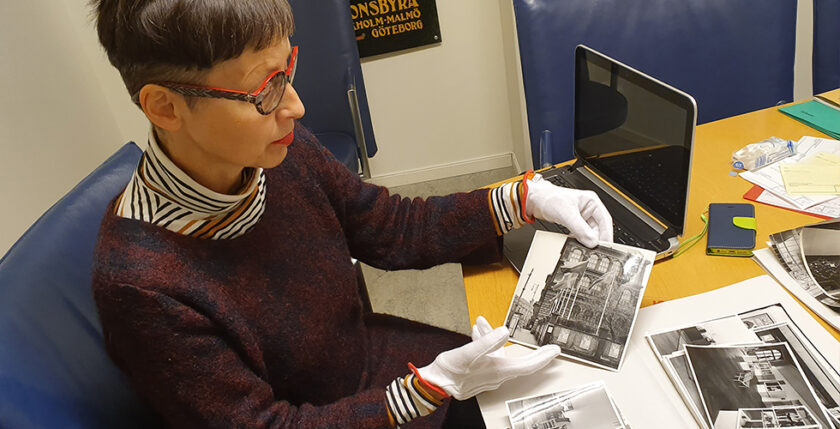
– And in Svensk Form's archives, much of what we did together was preserved. Look here, a photo of my own museum in Prague, taken in the 1920s! These are invaluable photographs for us today.
Iva Knobloch can now begin to fill the gaps in Czech industrial design history. – The historical writing in my country has become fragmented. Not only because of our communist era, but also due to the very abrupt introduction of capitalism in the 1990s. Much historical material was lost then, when everything had to be created anew. We are therefore so happy that our history is preserved with old friends abroad, like Svensk Form, concluded Iva Knobloch.