146 years ago, Robert Nobel, older brother to Alfred and son of Immanuel, came to Baku for the first time. The oil found there laid the foundation for his prosperity. Together with his brother Ludwig, he built the largest oil company the world had seen until then. Our Vadim Azbel recently traveled to Azerbaijan to follow in Nobel’s footsteps, together with Bengt Jangfeldt, who is writing a biography about the Nobel family. Here is Vadim’s travel story.
After a long wait at the baggage claim, our suitcases appeared there on the conveyor belt at Heydar Aliyev Airport in Baku, on October 13, 2018. Mine was half full of presents and immediately got stuck in customs control. “What do you have there?” the officer wondered. “Presents,” I said. “What kind of presents?” “Archive gifts,” I answered. The officer’s face went dark and bored. “Ok, you can go,” he said resignedly.
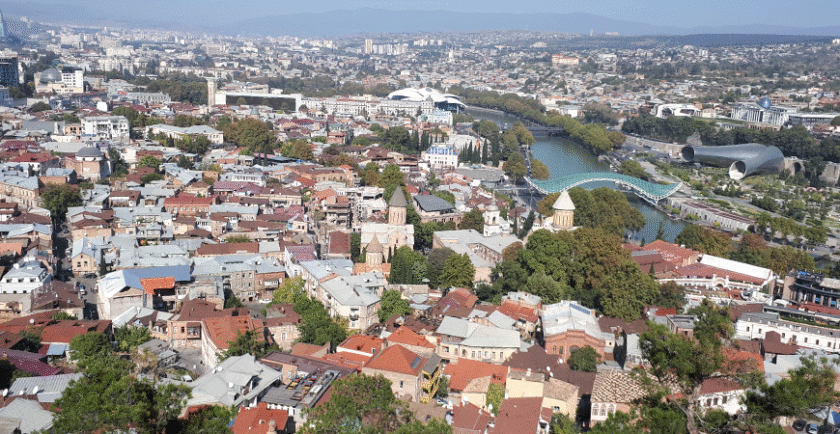
146 years ago, in 1872, Robert Nobel, eldest son of Immanuel Nobels, arrived in Baku, the capital of Azerbaijan. His journey had gone via Georgia, where he had traveled from Europe in search of walnut wood. The Baku he encountered was vastly different from the city that stands there today. The gradual transformation of Baku from a medieval trading town, one of many on the Silk Road to China, to today’s Dubai look-alike, is due to the wealth beneath the ground. For what primarily caught Robert’s attention in Baku, and which became the foundation for his and his brothers’ prosperity, has also created the wealth of the city and the entire region. I am of course talking about oil.
At the Centre for Business History, we have followed the footsteps of the Nobel brothers eastward for nearly two decades. The first contacts were made around the turn of the millennium, nearly a decade after the collapse of the Soviet Union, when the newly formed republics sought Western contacts. Since then, we have made several trips to Azerbaijan to see the legendary regions of the Absheron Peninsula.
Many other delegations have also traveled there. The first book that these trips resulted in was Brita Åsbrink’s “Ludvig Nobel. Petroleum has a bright future.” The book launched a major research preparation collaboration project between the Centre for Business History (CfN) and several state archives in Russia, Azerbaijan, and Georgia, a project which, among other outcomes, resulted in the website www.brothersnobel.se as well as a series of conferences and publications. (Among other things, there is much to read about this in our own magazine Företagsminnen, in issue five 2011. Download it as a PDF here.)
Read more about the Nobel brothers on our site
The oil production company Bröderna Nobel – or Branobel as it was called – was until 1917 Russia’s by far largest oil-producing company. It had almost a monopoly in the country and its significance is hard to overstate. Swedish, Russian, and Azerbaijani researchers have in recent years studied the company’s history. However, little has been written about the people behind the enterprise. The name Nobel today is primarily associated with the dynamite inventor who lent his name to a prize. That his brothers and their children built an industrial empire east of the Baltic Sea is generally much less known. Our trip to the Caucasus was part of the effort to fill those knowledge gaps.
The trip was also prompted by the book that Russia expert and author Bengt Jangfeldt is currently working on, for publication by our own publisher, Förlaget Näringslivshistoria.
It was therefore natural that Bengt joined the trip. Besides him, Tomas Tydén, vice chairman of the Nobel Family Association, and I myself joined the trip and got to see the City of Winds emerge from the smog beneath the airplane wings. Three middle-aged gentlemen in jeans and blazers. The agenda included visits and meetings with archive heads, ministers, club chairmen, ambassadors, museum directors, journalists, and the occasional local historian in the exciting cities of Baku, Tbilisi, and Batumi.


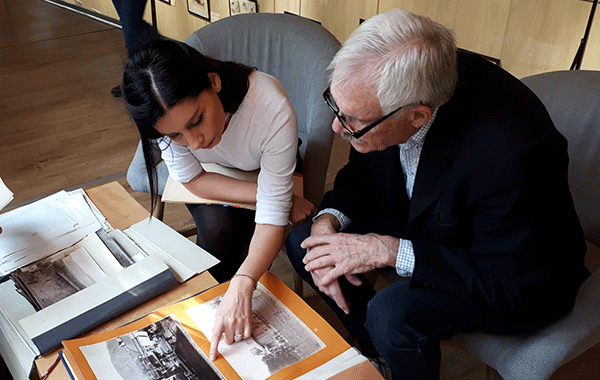


The day after arriving in Baku was spent on an excursion. Our small group was picked up by the Swedish diplomat Christian Kamill and his driver. Off we went to see Baku and its surroundings. We wandered around. Absorbed the aura of the historic sites. Strolled along narrow cobblestone streets. Touched the house walls. The oil-saturated wind swept in from the Caspian Sea. On the excursion, we also had Per Johansson as a guide, a painter and entrepreneur who left Sweden 15 years ago with his wife and settled in Azerbaijan. Over the years, Per has learned both Azerbaijani and Russian and acquired solid knowledge about the city of Baku and its history, a knowledge he was happy to share with us. For example, he ensured we familiarized ourselves with Icher-Sheher, the oldest and original district inside the fortress walls. A small oriental city gem, as if taken from the tales of One Thousand and One Nights, with winding and narrow alleys lined with small shops filled with carpets, saddlebags, shawls, hookahs, and sweets.
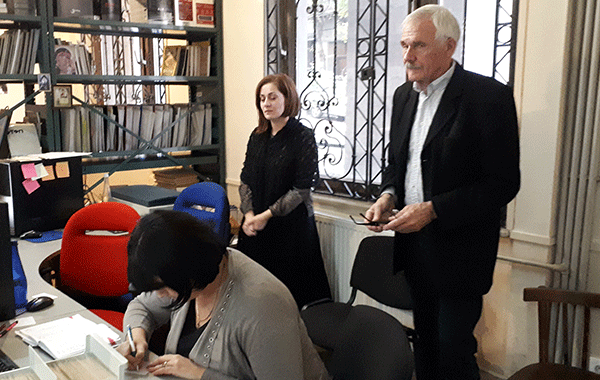
On Monday, the first official visit awaited at the National Archives of the Republic of Azerbaijan. The new acting head, Asgar Rasulov, received us in his office with the Swedish and Azerbaijani flags on the table and his closest colleagues around. A good, dark red tea was served in small glasses. The conversation centered on the project, the book, and archival research. It turned out that Asgar Rasulov, besides leading the overall archival work, also taught Turkish and translation technology in parallel at the state university. A well-read man with several translated as well as his own titles – who quickly found several common points with Bengt. After a tour of the archive, we calmly went through the catalogs and ordered materials, which we spent the rest of the working day studying.
The next day was spent partly reviewing archival material at the Film and Photo Archive, where spacious boxes of older photo material kept us busy for several hours.
The day ended with a visit to Villa Petrolea, the area in Baku built by the Nobel brothers for their employees and themselves, which today houses companies and a Nobel museum. During the visit, a new statue of Alfred Nobel was unveiled, donated to the Nobel Heritage Fund in Baku by an Azerbaijani businessman active in Russia. Concurrently, there was an art exhibition of paintings made by another Azerbaijani artist whose specialty is creating paintings in crude oil using his fingers.
Early the next morning, we flew to Georgia, where the same day we were received by Deputy Minister of Culture Levan Khartashvili and other representatives from the Department of Education, Science, Culture, and Sports. We presented our project and received the deputy minister's words of generous support. He compared the book project to a similar German initiative for the preservation of a two-hundred-year history of German settlements in the Caucasus. The evening was spent on a walking tour with a local historian, Emil Avdaliani, who spoke about famous houses and neighborhoods built by, among others, Armenian oil barons in Tbilisi at the end of the 19th and beginning of the 20th centuries.
The following day we visited the Georgian National Archives for a meeting with its head, Teona Iashvili. The Georgian National Archives have extensive international cooperation and several ongoing bilateral projects, such as joint archival exhibitions with material from Italy, France, Germany, Switzerland, and other countries. After a short tour, we were allowed to visit the archive and go through fantastic photo material that had been curated. We saw several albums with photographs by Dmitry Yermakov (1846-1916), born in Tbilisi, a military topographer but also an ethnographer, orientalist, and skilled photographer. It is somewhat difficult to imagine how this man, with the photographic equipment of his time, managed to visit so many different places and take so many pictures from completely different environments and contexts. Yermakov also traveled beyond the Caucasus, visiting Turkey and Iran. He depicted everything from oil wells in Baku to small children in some remote mountain village. He documented and named, he told stories and explained. He also bought other photographers' pictures that he liked. And he left behind a treasure of images that constitutes one of the most famous photo collections in Georgia.
From the National Archives, we moved to the National Museum, where we were received by its director, David Lordkipanidze, who inquired about the book project and promised to consult the museum archives (Georgia's National Museum comprises about fifteen different museums of national interest throughout the country). We were also allowed to visit the museum's own archive and, with the help of archive staff, went through photos themed "Nobel." The visit ended with a tour of the museum, whose exhibitions contain everything from ancient gold jewelry and utensils to medieval costumes and icon paintings.
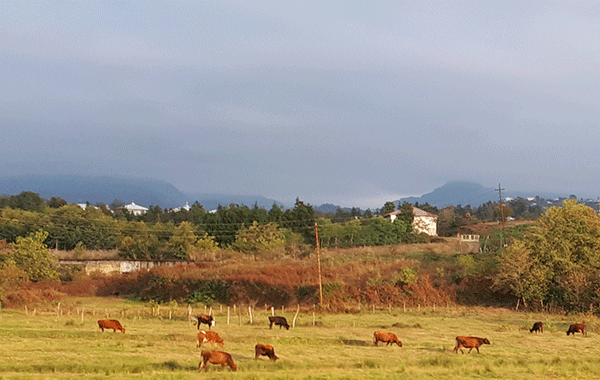
The trip from Tbilisi to Batumi took a whole day and we traveled through half of Georgia from east to west. Along the way, the driver told us about the cities and villages we passed, including the former Georgian capital Kutaisi, which until very recently housed the relocated Georgian parliament, a venture similar to the decentralization of government agencies in Sweden.
We also took the opportunity to make a detour to a small village, Bagdadi, the birthplace of the great Russian poet, Vladimir Mayakovsky, whose biography has occupied Bengt for almost 40 years. Our unexpected arrival at the Mayakovsky museum stirred strong emotions. Both the director and first curator of the museum were taken by surprise. They had not expected to meet the world's leading Mayakovsky expert in person. It became even more solemn when it became clear that Thomas was directly descended as a great-great-grandchild of Ludvig Nobel.
Upon arriving in Batumi, a visit awaited at the regional archival authority with administrative leadership as well as archive and museum staff. After an official meeting with Maka Ivanshvili and her colleagues, we engaged in archival research before moving on to the local historical museum and the Brothers Nobel Batumi Technological Museum.
The day ended with a swim in the Black Sea. A much-needed relaxation considering the long flight back home the next morning.