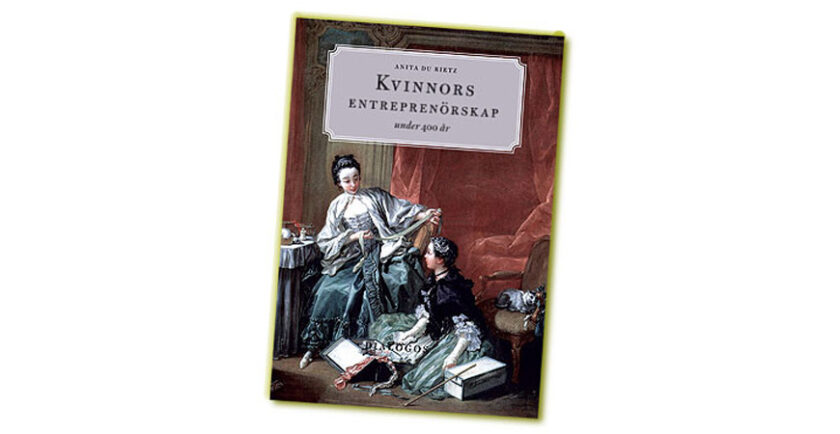
There is a generally accepted truth that Swedish women were freed from their shackles in 1921 with the advent of democracy. Today, they stand indebted in gratitude to their political liberators, and the illusion lives on. Sure – women are largely equal in Sweden, but this does not apply to economics and entrepreneurship. One should not forget that women's actions were a driving factor behind the onset of the industrial revolution, also in our country. This is shown by Anita Du Rietz in her new book. They entered the entrepreneurial role early and actively contributed to the revolution of entrepreneurship in the mid-1800s. In the 1930s, entrepreneurship slowed down, and after 1950 fewer women became entrepreneurs but more were employed.
The book is an attempt to place women's entrepreneurship in a larger context. Women's conditions as actors in the business world have not been the same as men's, and this difference is clarified. The equality issue takes on a new form, and with different historical glasses, our current business policy critical issues also appear in a new light. Many different research efforts are referenced in this book, and a new image emerges with women who had the right to vote, inherited, and ran businesses far back in time.
Anita Du Rietz holds a Ph.D. in economics with a focus on entrepreneurship, innovations, and institutions. She has previously been chief economist at Föreningsbanken and started the Small Business Barometer. She is also a fellow researcher at the Centre for Business History.
Questions/interviews: contact Anita Du Rietz, phone 070-274 00 33 or 08-756 90 78 or anita@durietz.com
Review copies, images, and other questions: Contact Jolanta Wadensjö, Dialogos Förlag, phone 08-15 46 97 or 0730-49 77 25 or jolanta.wadensjo@comhem.se
Women's entrepreneurship over 400 years
Anita Du Rietz
DialogosFörlag/Centrum för Näringslivshistoria
ISBN 978-91-7504-257-2
524 pages