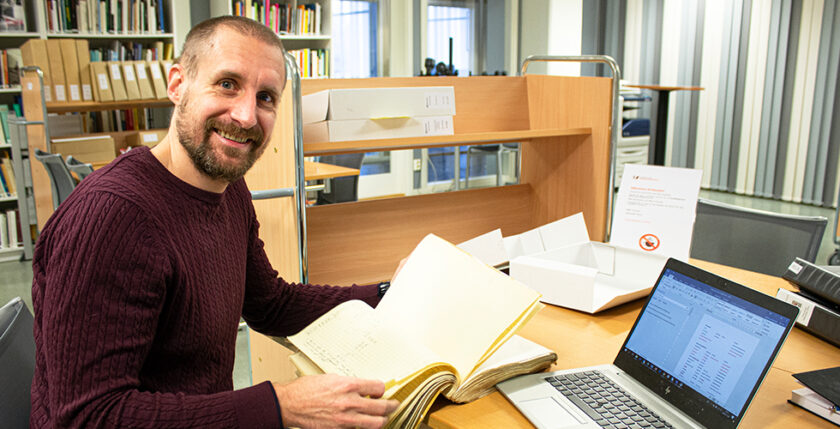
Already in the mid-19th century, Swedish companies were doing business in the area that is today South Africa. Matthias Holmstedt, lecturer at Mälardalen University, is conducting research in our reading room for a book on this exciting subject.
Originally, it was meant to be about Atlas Copco's presence on the African continent, but it ended up being limited to the South Africa area and instead looks at several different Swedish companies that have operated there. He has therefore spent quite a bit of time going through material in the archives of the Center for Business History.
‒ Several Swedish companies were very early in their contacts in the area. This was also connected to a certain Swedish migration to southern Africa, says Matthias Holmstedt. He previously earned a doctorate with a dissertation on Ericsson's history in Africa, and it was that work that sparked the interest to delve further into the fates and adventures of Swedish companies on the African continent. This time he has chosen to concentrate on the years 1840–1947 and the companies whose traces he follows are Ericsson, Atlas Copco, Bolinders, Electrolux, Alfa Laval, and Aga. Around the turn of the 19th to 20th century, South Africa was Sweden's largest non-European export country.
‒ It gives a somewhat different perspective on foreign trade. But it's not just about export issues; I also want to highlight the companies' stories in this somewhat unlikely history that involves two countries in such different parts of the world.
Several of the companies are still active in the area, and many others have of course appeared over the years. His choice to end his review in 1947 has several reasons. Partly, the conditions for international trade changed through the GATT agreement, and partly the apartheid regime came into effect in 1948.
‒ The years directly after World War II are especially interesting because exports exploded then. Sweden had an enormous advantage compared to, for example, the United Kingdom and Germany, and in South Africa, there had been significant industrial development.
The book is funded with the help of Handelsbanken's research foundation and is published by Förlaget Näringslivshistoria. It is set to be released just in time for the 2020 Book Fair, which fittingly has South Africa as its theme country. And perhaps it may eventually also become a continuation where Matthias Holmstedt takes on the years during apartheid.
‒ That would be interesting, but those years are a bit sensitive for companies and the information is not always saved in the archives.