Just over 100 years ago, Sweden began to electrify in earnest. The state took a leading responsibility for the expansion of Swedish hydropower and the Royal Vattenfall Board was established.
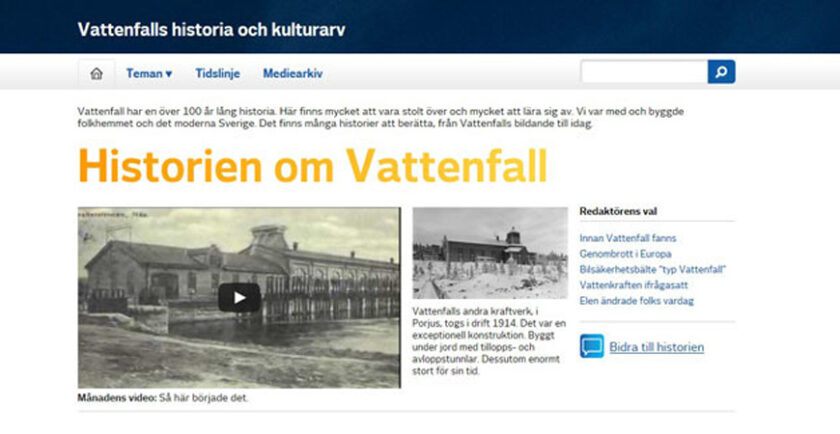
Now Vattenfall's history is told on the websites history.vattenfall.com (English version) and historia.vattenfall.se (Swedish version). Here, not only the years of hydropower expansion are depicted, but also how Vattenfall invested in nuclear power plants and alternative energy sources. And how the company developed from a state-owned enterprise to one of Europe's largest energy companies.
Sweden's electrification is one of the greatest infrastructure projects of our time. The purpose was to supply both Swedish citizens and industry with cheap electricity. The expansion of hydropower began already at the start of the last century, when the Swedish state decided to develop the rapids in Trollhättan. This state project was so successful that the state decided to take responsibility for hydropower expansion itself. The Royal Vattenfall Board was established for this purpose in 1909.
The website has been produced in close collaboration between the Centre for Business History and Vattenfall's Heritage Committee.
– We are glad to have been able to tell Vattenfall's history in a modern way via the web. Vattenfall's history is relevant, as the company has had an enormous significance for Swedish industrialization, not only by supplying Sweden with cheap electricity. By Vattenfall forming a development pair together with Asea, Sweden also became world-leading in high-voltage technology, says Alexander Husebye, CEO of the Centre for Business History.
The website contains approximately 50 historical articles, about thirty films, and 300 images. The website is available in both Swedish and English. Minimedia is responsible for the technical solution and Nilson Mace has done the design.