
This text is from:
History Marketing - The History of Companies as a Strategic Asset (Business History Publishing, 2023) by Anders Sjöman.
Where we note that companies like to mention how old they are, agree that history is important to humans and amaze at how, despite this, companies often still try to break free from what has been. When they could be using their heritage to propel them forward.
By Anders Sjöman.
From History marketing - Using history as a corporate strategic asset(2023).
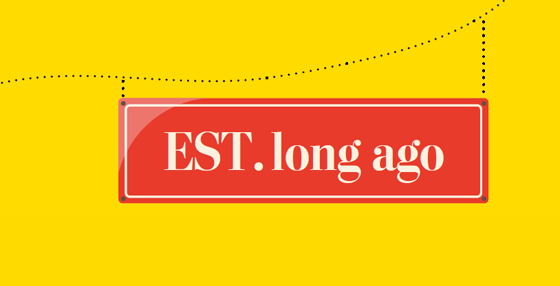
At the Centre for Business History, we have worked with preserving and presenting business history since 1974.
See what I did there?
I slipped in our founding year, to show that we have experience and, therefore, credibility too.
Granted, it's not a very original idea. Take a walk around any city and you’ll see business signs everywhere saying “est.”, “since” and “since” followed by a year. Whether it’s dry cleaning, food or curtains, businesses want to show that they’ve been around for a long time. The founding year is a simple way of saying: “We know our stuff, why else would we still be around.”
Once you start noticing the founding years, you see them everywhere. Walking through the streets of my native Stockholm, one sign tells me people have slept in beds from Hästen’s since 1852 and another that Taxi Stockholm has been taking people where they need to go since
1899 (presumably in horse-driven carriages then). Driving on the highway, I pass a truck from the transport company Savviko, which tells us that they have been “carrying goods since 1948.” At home on the sofa, Marabou’s chocolate package Paradis is “a tradition since 1957” and the beer bottle from Spendrups clearly says 1897.

This is certainly not a uniquely Swedish phenomenon. At Hamleys Toys in London, people have been buying toys “since 1760”; Scotland’s Talisker has been making whisky since 1830; Lindt has been a “maître chocolatier suisse” since 1845; and America’s Krispy Kreme has been making doughnuts since 1937. In Italy, the drinks menu is overflowing—with dates: Fernet Branca (since 1845), grappa from Poli (founded in 1898), or a Peroni beer (brewed since 1846).
In South Africa, shirt maker Presidential was “established 1994.” Perhaps not that long ago—but the symbolism is powerful, since the country abolished the apartheid system that same year.
You don’t even need to know the exact year. The workshop Gummicentralen in Norrtälje has been selling tires “since the 1930s.” “My grandfather started the company, we just don't know when exactly,” said owner Andreas Björklund when I asked him.
Even young companies can display their starting year. Ever since its first year in business, Happy Socks has written “Est. 2008” on its socks. Given today’s fast pace of business, I think that makes sense: a ten-year-old company may have accomplished as much as it took an old industrial company 50 years to go through.
Company acquisitions raise new questions about founding years, especially when a young company buys an older one. The audiobook company Storytel, founded in 2005, now owns Sweden’s oldest publishing house, Norstedts, founded in 1823. How old is Storytel really?
And the advertising company Clear Channel claimed on billboards in Stockholm that they had “been outdoor pioneers since 1879,” even though they were founded in Texas in 1972. They aged rapidly by acquiring Swedish Wennergren & Williams, whose origins lie in poster printing company, William & Co, founded (that’s right) in 1879. Clearly, they saw brand strength in the older company’s founding year.

Of course, there’s no inherent need to claim that the parent company is as old as the oldest company it has acquired. Instead, the acquisitions can be presented as the separate components they are. The pharmaceutical company GSK, short for GlaxoSmithKline, was formed in 2000 through the merger of GlaxoWellcome and SmithKline Beecham. These comapnies were, in turn, mergers of Glaxo and Wellcome, and of Smith Kline Beckman and Beecham Group—which also were the reults of even earlier mergers. Today's GSK therefore points out that the company is built on a legacy inherited from earlier brands. It frequently highlights all its roots, of which the oldest leads to a pharmacy in Plough Court in London dating back to 1715.
The food group Axfood (which includes Swedish mainstay brands such as Willys, Hemköp and Dagab) does the same. Axfood was formed as an independent group only in 2000, but its constituent businesses have roots dating back to the early 20th century. That's why Axfood calls itself “a young company with a long heritage.”
As the examples of GSK and Axfood show, companies can -- just like normal families -- build family trees showing all the businesses that underpin today’s operation. We have previously created such trees for Skandia and Trygg-Hansa, two Swedish insurance groups.
By making each individual historical component visible, nothing is claimed about today’s company that cannot be verified. At the same time, it becomes clear that today’s company is built on shared experience. For what is history, if not shared experience?

What the examples actually also show that it is not always entirely clear which year a company actually was founded. But regardless of which year is chosen, it is good to be able to justify the company’s approach by tracing it back through time. The outside world will always question how authentic the company’s historical thread really is.
Which I did myself, when I sat down to eat at the Old Ebbitt Grill restaurant in Washington, D.C.
The restaurant’s logo said “Est. 1856,” and they called themselves “the oldest saloon in Washington.” But the place had changed addresses, décor, and owners many times over. Was there really anything left from 1856 besides the name? Was that enough for the restaurant to credibly refer to its history?
It brings to mind the story of the young lumberjack who proudly uses his grandfather’s old axe. Except he just replaced the handle, and his father replaced the axe head a few years ago. Is it still his grandfather’s axe? (You may recognize this as the Theseus Paradox.)
Well, in a way, yes—it has been passed down through genereations, even though parts have been replaced. Just like the restaurant. So I decided to give the Old Ebbitt Grill a history-user's thumbs up: it has been around since 1856.

Some companies address the question of dates much more creatively—they use the founder’s birth year. Swedish clothing brand Bondelid started in 1971, but its sweaters say “Born 1956,” the year founder Claes Bondelid was born. Health food store KZ Clean Eating in Stockholm had “Est. 1977” in its logo, although the company started in 2012--because founder Katrin Zytomierska was born in 1977. (The store is now closed.) In search of a steady historical keel, these companies seem to have looked for the oldest date floating around.
However encouraging it is to see starting years prominently used, it doesn’t really say much
about a company’s general interest in history. For many, stating their founding year, and perhaps also including a simple “foundation story” on their corporate website, is the only form of history use they ever engage in.
At the Centre for Business History, we still see it as a good start. The year shows that there is a small seed of interest in history. We can build on that when we want to show how history can actually be used to create pride, trust, and a sense of community—both internally and externally.
But more on how to do that in later chapters. First, let’s look at what history means to us as human beings in general. That also matters when it comes to how companies use history.

Some may say that people don't care much about that past, that we live in times where all everyone focuses on is the future. At the Centre for Business History, we disagree. On the contrary, we see growing interest in history.
Just look at your local shop's magazine shelves, where history magazines dominate the racks. On TV, there are shows like Who Do You Think
You Are? for genealogy and A House Through Time for architectural history,
not to mention Antiques Roadshow. History podcasts are popping up on all platforms. In Sweden, public service radio has been airing a new
episode of Science Radio: History (Vetenskapsradion Historia) every week for
over ten years. They just celebrated 1,000 shows.
This interest is also evident in the workplace. HR managers often point to two groups who are especially curious about a company’s history: young, newly hired employees who want to understand the context they are entering, and veterans who want to sum up their working lives before retirement. History simply creates meaning, both at work and in life. If you know where you come from, it is easier to understand where you are and where you are headed. Winston Churchill,
Britain’s wartime Prime Minister, has quotes for most things, including this:
“The longer you look back, the farther you can look forward.”
But our longing for meaning also makes us easy to fool. We are inclined to believe falsehoods if they sound good enough. Are you really sure that what you have just heard is true? Is it historically verified enough for you to pass the story on without risking telling a falsehood?
Early in 2018, a photo circulated on social media showing three pipe-smoking women arm in arm on a beach. The caption claimed they were Rosa Luxemburg, Simone de Beauvoir, and Emma Goldman in the 1930s. For anyone who admires strong historical women who have influenced the development of the world, the photo was amazing. Imagine—they were even friends!
The only problem was that the photo showed three completely unknown women. The three famous ones did not even live at the same time. Luxemburg was murdered in 1919, when de Beauvoir was only eleven, and she never met Goldman, who was 40 years older.
A quick fact-checking bursts the bubble immediately. But we so badly want to find powerful historical moments that we forget to think critically.
Or, as the English statesman and philosopher Francis Bacon is said to have remarked back in the 1600s, “Man prefers to believe what he prefers to be true.”

Because we humans are so fond of a good story, it is easy to manipulate history. That is why, as a serious user of history, it is essential always to rely on facts and source-critical research. We are the counterforce to fake news, misleading information, and alternative facts.
Even though history is a perfect fit for marketing and concepts like storytelling, you must never compromise on the truth. Serious use of history is about telling fact-checked history, about verified storytelling. The business rationale is simple: a company caught embellishing the truth will loose its customers’ confidence. No one trusts someone whose wording is guided by what sounds good rather than by what actually happened.
That is why authentic is a keyword in our definition of history marketing. The National Encyclopedia defines “authentic” as something that “really existed in the way it is claimed to have,” and its opposite is the fictional and made-up. The word comes from the Greek authentikos, meaning “reliable; something based on demonstrable evidence.”

It turns out that authenticity is also good for business.
When consulting firm Stackla (now Nosto) surveyed 2,000 consumers in the US, UK, and Australia in 2017, 86 percent said authenticity determined which brands they liked. People prefer “real and natural over perfect and packaged.” I realize the study’s questions mainly concerned companies’ transparency about their products and production processes, but I see the conclusion as applicable to a company’s writing and interpretation of its own history as well.
When the study was repeated in 2019, the figure had risen to 90 percent. At the same time, most people felt that fewer than half of all brands actually seemed authentic.
Companies with a true story told authentically have a huge opportunity to stand out. We explore how to do this effectively, and the important considerations involved, in more detail in chapter 3.
It’s always interesting to note that even if you stick to the facts, there’s more than one way to tell history.
Of course, what happened did happen. Events and processes don’t change. But our understanding of why they happened is constantly changing. New facts emerge. Over time, we also gain a better understanding of the dynamics behind events. In addition, social issues that we now consider important, but that weren’t on the agenda in the past, lead us to study historical events anew through fresh eyes.
Today, gender equality and sustainability are obvious perspectives when examining historical developments, whereas earlier researchers asked different questions. When we examine an old company story through the lens of today’s concerns, we can suddenly gain a whole new understanding of historical developments—almost as if discovering new history.
Take the Zoégas coffee roastery, founded in 1886 in Helsingborg. For a long time, the story was that the company had been built by Carlos Zoéga. But the sources show that Carlos died just two years after the company was founded. The person who actually developed the company was his wife, Maria Zoéga. She simply didn’t appear in the early documents because married women were legally incapacitated and could not sign contracts. It wasn’t until she became a widow that she gained legal capacity—and began to leave traces in the archives. When she remarried in 1890, her name disappeared again (married women did not gain legal capacity until 1921). Maria ran and developed Zoégas for decades and was a well-known businesswoman in Helsingborg, but disappeared from history after her death. That “erasure,” too, may have been typical of her era, when women were uncommon as business leaders and their stories were not retold in the same way as men’s. Only when researcher Anja Petersen examined old archives did Maria receive the recognition she deserved. In 2018, the company apologized in full-page ads under the headline “Sorry, Maria!” and told the fuller story behind Zoégas’ founding.

Sometimes, new facts simply emerge that rewrites history. The news organization Associated Press (AP) believed it was founded in 1848 and therefore celebrated its 150th anniversary in 1998. But in 2005, documents were found showing that the founding year was 1846. Its bicentennial celebration will therefore be held just 48 years after its 150th birthday party!
Or take the Swedish bicycle maker Skeppshultcykeln, which celebrated its 50th anniversary in 1970 and counted 1920 as its founding year. This was the year the company was registered and a new factory was built. Documens discovered later, however, showed that bicycles had been made there in 1911—and probably had been going on for quite some time too.
It is currently impossible to pinpoint the exact year Skeppshultcykeln started. All we can say is that the company is at least this-and-that many years old.
Anders Houltz, our head of research at the Centre for Business History, often reminds us that we always describe the past from the perspective of our own time. In preparation for this book, he wrote to me: “That is why our views of history are also about the present and our hopes or fears for the future. The old historians’ joke is true: history never turns out the way it was.”
That is precisely why a company must never stop telling its story. It must be kept alive so that we can continue to explore it with fresh eyes.

I can almost hear the objections to what I just wrote. “Do we really have to talk so much about history? It takes time, and we have to focus on the present!”
That attitude is old. You could almost say it’s... historical.
Already in 1916, car giant Henry Ford said in an interview: “History is more or less bunk. It’s tradition. We don’t want tradition. We want to live in the present, and the only history that is worth a tinker’s damn is the history that we make today.”
Later, Henry Ford added that he had really only talked about history as a school subject, and how the way history was taught in school did not reflect people’s everyday lives or tell how life really was.
So perhaps Ford wasn’t quite as angry with history as the myth suggests, but was mostly just giving voice to his era, as modernity surged forward in the wake of industrialization.
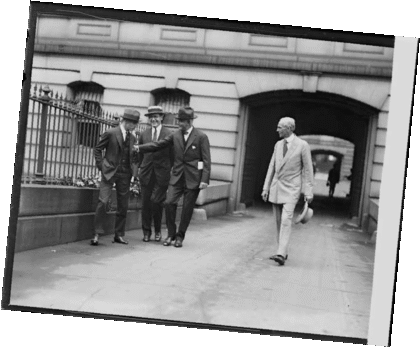
However, even today, it is easy to find people who seem irritated at having to think about history. When a Swedish editor-in-chief was recently asked, after leaving her job, what she could have done differently, she replied: “I’m not someone who looks in the rearview mirror and wonders what other choices could have been made. I’m someone who lives in the here and now and looks ahead.”
The rearview mirror, by the way, seems to be a popular metaphor for expressing distrust of history: “Relying only on historical data is like driving a car while looking only in the rearview mirror,” a financial researcher recently wrote in an opinion piece.
I agree with the word only. No one drives a car by looking only in the rearview mirror, but the it from time to time does make you a safer driver. Who probably lives longer than those who don't.
What these people may still be worried about is that we never quite get history “right,” as the examples of Zoégas or AP might be thought to show. Why then spend any time on history at all?
Or perhaps they worry that history prevents an organization from thinking innovatively. What if history means you just keep following well-worn historical tracks without being open to new solutions?
These business leaders, probably without knowing it, are then talking about what is usually called path dependence.
The concept was coined in the 1980s by economic historian Paul David. It starts from the premise that history absolutely matters to an organization’s development—but not in a positive way. David argues that early decisions in a company’s history can easily become entrenched, causing the business to continue along old tracks out of sheer habit, even as the world around it changes. The alternatives that the business once considered are forgotten, and what happened is seen in hindsight as the only thing that could have happened. (This is sometimes called “backward history”; more on that later in the book.)
Examples often cited as warnings about “path dependence” include camera maker Kodak, which missed the shift to digital cameras, and Swedish company Facit, which stuck with mechanical calculators as electronics took over.

In situations like these, the company must actively decide to break free from its established path, just as it once decided to set out on that path.
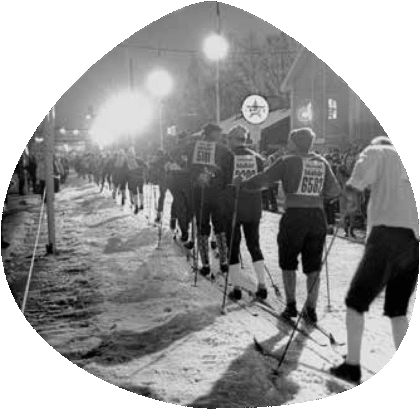
Do you cross-country ski? Think of path dependence as picking the right-hand track during a long-distance race, where there are many parallel tracks to choose between. That righthand
track feels safer, and you leave the tracks to the left for the speedsters. But suddenly a group of skiers in front of you crash and fall in a downhill section. If you don’t want to fall yourself, you have to make an active decision to change tracks. You must break free from your path dependence, even if that track has served you well up until now. Circumstances have changed – and you must too.
Switching tracks in the business world doesn’t have to involve only products, as in the cases of Kodak and Facit. It can just as easily involve organizational structure or management. In 1940, Atlas Diesel brought in a new CEO—from the retail trade, Walter Wehtje. He steered the previously engineer-led company away from its familiar diesel engines and invested in compressed air. In the process, the company changed its name to Atlas Copco. Despite many skeptics, it was a success.
And recently, Atlas Copco switched tracks again when, in 2018, it spun off its historically important mining and construction division into the new company Epiroc. All to adapt once again to a new era.
At the Centre for Business History, we understand business leaders who are afraid of getting stuck in old ways. Blindly celebrating everything that came before is dangerous. But good history marketing is not about getting bogged down in the past, it is about bringing relevant knowledge from the past along on the journey forward.
We explain how to find that balance in chapter 4, where we walk through our history marketing process. In the meantime, two wise quotes sum up the approach. In 1979, German historian Karl-Ernst Jeissmann wrote that historical consciousness helps us “connect interpretations of the past, understanding of the present, and perspectives on the future.” And composer Gustav Mahler said much the same thing, long before and even more briefly: “Tradition is passing on the flame, not worshipping the ashes.” (Naturally, he said it in German: “Tradition ist die Weitergabe des Feuers und nicht die Anbetung der Asche.”)

THIS CHAPTER was on purpose structured as a “on-one-hand-but-on-the-other-
hand” discussion about the general perception of history. In the next chapter, we'll establish firmly, once and for all, why history truly is a strategic asset for coampanies. The chapter starts here.
History Marketing - The History of Companies as a Strategic Asset (Business History Publishing, 2023) by Anders Sjöman.

Updated