
This text is from:
History Marketing - The History of Companies as a Strategic Asset (Business History Publishing, 2023) by Anders Sjöman.
Where we dicuss the key decisions that all users of history must make, regardless of if they are just starting out with history marketing or if they’ve been at it for a while..
By Anders Sjöman.
From History marketing - Using history as a corporate strategic asset (2023).

A COMPANY’S HISTORY can be told in many ways. Over the years, we at the Centre for Business History have helped companies create historical websites, films, anniversary books, monographs, exhibitions, theater plays, installations, lecture series, corporate museums, and much more. The format that works best depends on what the company wants to achieve and which groups it wants to reach. In Chapter 4, we present a process that can help with that choice. But in this chapter, we want to go through some other important considerations that everyone using history faces.
Every company’s history, young or old, is full of stories. They are about people, events, and developments; they include both successes and setbacks. But it is rarely possible to tell all the stories that make up a company's heritage. So the first thing someone using history usually realizes is that they will need to choose from all the stories they could tell.
Tips on how to identify the most compelling stories can be found in chapter four. But we’ll cover one fundamental point here, because it’s easy to instinctively choose only success stories. Breakthroughs, innovations, and successful initiatives demand attention. But few people believe a story that goes from one success to another. Business, like life, has its ups and downs. Often, it is the setbacks and failures that most clearly show what a company is made of.
Furniture giant IKEA took this to heart in 2019. Together with advertising veteran Hans Brindfors, the company published the book Only Those Who are Asleep Make No Mistakes, about 15 crises that shaped IKEA. Across 256 pages, it recounts everything from poisoned bookshelves to child labor in carpet factories—events that prompted the company to reconsider its ways of working. The book is distributed to employees, and the back-cover blurb explains why: “So that those working on the next step won’t forget.”

That doing business involves taking risks is self-evident, and not every initiative succeeds. Such stories also belong in an active use of history. For example, Ericsson often tells the story of how the company was ahead of its time with both videotelephony (in the 1960s) and tablets (in the early 2000s). The technology existed, but the conditions were not right: in the 1960s, there were no networks capable of supporting streamed video, and in the early 2000s, consumers did not have data plans with large enough allowances. The idea was right, but the timing was wrong. Ericsson uses these examples internally to show why the company must keep pushing the boundaries, even if that sometimes leads to failure.

It takes a brave corporate leadership to support projects like IKEA’s “crisis book.” Or an executive board that recognizes the value of past failures, as with Ericsson.
But a nuanced use of history is possible also at levels below the top management team. We have met many communications and marketing departments that stand firm on telling the company’s whole story, rather than just picking the cherries. That kind of persistence often lays the groundwork for successful use of history.
Even though we don’t recommend cherry-picking from the history cake, we can still understand the motivation behind doing so. However, there is a much worse form of history marketing: the fully fabricated one.
For example, for a long time the clothing chain Hollister had new employees hear the story of how John M. Hollister left his comfortable life in Manhattan, sailed in the South Pacific with his love, Meta, and then came ashore and opened a store in Los Angeles in 1919. Their son, John Jr., was supposedly later to have turned the store into a surf shop selling his own clothes—which then grew into a large chain of stores.
A nice story—but completely made up. In reality, the brand was created in a project room at its owner Abercrombie & Fitch, which wanted to develop a new store concept.
(Incidentally, there is a city in California called Hollister. The clothing company has sued stores there that printed the city’s name on T-shirts. Something The New Yorker wrote a great article about.)

Even the origin story of the auction site eBay has turned out to be fabricated. According to the story, Pamela Wesley wanted to sell her collection of Pez dispensers and asked her boyfriend Pierre Omidyar for help. In 1995, he built the AuctionWeb site, which later became eBay. It is true that Omidyar built the site, but his idea from the outset was to exactly what the site became: create a structured marketplace for online auctions. The “Pez myth” was a PR hoax, the company itself now admits on its history page.
Another example is Enzo Bartoli wine, which was introduced to the Swedish market in 2018. It was said to be named after a wine producer from Piedmont, born in 1897 in Nizza di Monferrato and devoted to the land, the wine, and the people of the region. But the person was made up. The wine was produced by one of Italy’s largest companies specializing in custom-designed wines and had no connection to any historical person. The wine importer withdrew the claim when the hoax was exposed. Almost. Today, Enzo is described as a myth, “created to personify our idea of the wines of Piedmont.”
There are also companies that borrow a historical affiliation for their brand, sometimes called an “adopted history.” The Swedish textile company Lexington, founded in Borås in 1997, bases its range and marketing on a lifestyle inspired by New England on the northeastern coast of the United States. Morris Stockholm, founded in 2004, similarly draws inspiration from the classic preppy style associated with exclusive American private schools.
It should be stressed that neither Lexington nor Morris Stockholm claims to come from the places that inspire them. They are clear about their Swedish origins and why they chose their concepts. It's a transparency that I appreciate. These examples still show, however, the appeal of certain historical settings and how eagerly startups build their own brands around them, despite having no personal connection to that history.
We previously discussed the importance of not just telling success stories when using history, but also including failures and setbacks. Set in their historical context, they enrich the picture of a company’s development. Then there are often things that are not flattering at all, regardless of perspective. But these, too, need to be included in the use of history.
For example, all German companies older than 75 years must consider how they acted under the Nazi regime of the Third Reich. The issue became especially clear in the 1990s. The fall of the Berlin Wall opened previously closed East German archives to researchers. (I already told this story in the beginning of the book but reiterate it here to make a point about transparency.) They contained detailed accounts of how German companies had acted during the war years. In reunified Germany, debate also grew about Holocaust victims’ money in so-called “dormant accounts” in Switzerland and compensation for forced laborers in the German war industry. More and more demands and lawsuits were directed at German companies.
It became clear for older German companies that they had to account for their operations during the 1930s and 1940s. It took years to clarify what had actually taken place and how the companies should address what they found.
However, as a result of the process, and the structured corporate archives that the companies often ended up creating, they became much more aware of their own history and all the events it held. These archives thus enabled a more comprehensive storytelling, which could also lift brighter aspects of the companies’ pasts.
Companies that have worked under more democratic conditions than those of Nazi-era Germany may still have financial scandals, bribery, environmental destruction, and other issues to deal with. Active use of history must take such things into account, because the outside world and the company’s stakeholders will do it anyway. A history of the pharmaceutical company Astra Zeneca can hardly omit either the blessing of Xylocaine or the shocking effects of Neurosedyn. The IKEA company museum covers both the company’s successes and founder Ingvar Kamprad’s youthful links to Nazi groups.
All company histories are stories with many layers. They all form part of the developments that have made the company what it is today. If history is to contribute to a credible and authentic brand, the negative parts must also be included. They do not need to dominate the narrative, but it is neither wise nor particularly feasible to turn a blind eye to them. By telling these stories themselves, companies can get ahead of others’ interpretations and inaccurate accounts. “Shape the story yourself, or someone else will do it for you,” as communications consultants often say. Brand damage is also often greater when a company is caught hiding skeletons in the closet. Thoughtful use of history can, on the contrary, become part of a company’s crisis preparedness.
Companies that dare to talk about questionable actions can also show that they have learned from history and made amends. The history of the mining company LKAB can be told primarily as a story about the ore fields in the far north of Sweden and their importance to Sweden’s development. But it also has dark chapters. In the early 1910s, LKAB took part in race biology projects among the region’s Indigenous population.
This is a part of LKAB’s history that no one is proud of today, but it was naturally included in the comprehensive book about LKAB’s history that the company produced in time for the celebration of its 125th anniversary in 2015.
Leaving it out would have been a distortion of history, the company reasoned—and also easy to spot. All local residents know the story, and many are descendants of those who were subjected to it. By acknowledging the misstep, LKAB could instead show that it wanted to give an authentic picture of its history. Norrländska Socialdemokratens reviewer called the book an “educational triumph” and “the best overview published about the Norrbotten ore fields.”


Similarly, the oldest universities in the United States need to consider their history during the era of slavery. Several were founded by people who had built their fortunes through the slave trade or businesses that relied on enslaved labor.
Brown University, founded in 1764—long before the Civil War of 1861–1865 and the abolition of slavery—appointed an independent committee in the early 2000s to investigate the university’s ties to slavery and the slave trade. The Steering Committee on Slavery and Justice worked for three years. Its final report listed the university’s founders and benefactors who had been slave owners or slave traders.
Today’s university leadership could do nothing about the fact that the school had been built with “dirty money,” but it did establish a center for research on slavery in North America. Discussing historical wrongs and mistakes regularly is also one way to try to prevent them from happening again.

Such a historical review is similar to the financial due diligence conducted before a company acquisition. Many companies should probably conduct their own “historical due diligence”. It is better to know about the mistakes that were actually made than to worry about every possible misstep that may never have happened.
Often, there are no skeletons in the closet at all. But companies that know little about their history may let fears about possible dark sides prevent them from making active use of their history. At the Centre for Business History, our experience is that concerns about improprieties are almost always exaggerated and usually unfounded. The skeletons that do turn up tend to be small and fragile—and easy to understand in their historical context. Like the trolls in fairy tales, they burst when they come into the light.
Some companies worry about the opposite: that they have no interesting history at all. Perhaps there are no great successes or remarkable cultural heritage to show off. It is also easy to forget what you have really done when you are constantly occupied with day-to-day operations. When the question of archives and use of history first came up at clothing retailer H&M, someone is said to have remarked: “We don’t have a story to tell, do we? We just sell clothes.” But a company that has survived for a long time in a competitive market has done a lot right and managed to stay relevant in different eras. In H&M’s case, on a constantly changing global market.
As we like to say: companies are not good because they are old, they are old because they have been good at what they do.
A history naturally leads up to what exists today. But there is a pitfall. The person telling the story already knows the “answer” and can easily make what actually happened seem like the only possible outcome. It is difficult to keep all the alternative developments in mind. In a sense, you know the punchline before the story has even begun.
Nina Wormbs, professor of history of technology at KTH, has said: “If you look at an event or a development and try to figure out why that particular thing happened, you will inevitably find a cause of some kind, because after all it did happen.”
Looking for causes is, of course, an important part of a historian’s work. But in retrospect, causes can seem obvious, even though they were not at all to those living through the developments. The risk then is that we describe history as if things had to unfold exactly as they did. This is sometimes referred to as writing history in reverse or writing it backwards. “It is easy to write history only in hindsight, that is, to explain why what happened also had to happen,” as the historian Göran B. Nilsson put it.
In every situation, there were actually several possible paths forward. Often, the interesting story lies less in what those involved ultimately chose and more in what alternatives they had—and, even more, why they chose as they did. When someone making use of history tries to put themselves in their shoes, rather than viewing the situation with the benefit of hindsight, the story is often much more interesting.
So it is important to remain open to how history could have unfolded, not just how it actually did. I draw inspiration from the many “what if”-stories in popular culture, such as the films Sliding Doors (1998) and Everything Everywhere All at Once (2022). Marvel has played with alternative universes since its comic books of the 1960s and continues to do so with its What If series (2021) and the many multiverse films released as part of the Marvel Cinematic Universe.

All these stories challenge the idea that what happened was the only possible outcome. They remind us to view historical turning points in light of the circumstances at the time, and to tell the stories of the alternatives that existed but were never chosen. That is how we write history as it should be written: forwards.
Companies that choose to see history as a strategic asset soon recognize the need to protect and preserve their own history, just like other important assets. But what exactly is it that needs to be preserved and cared for? Or, to put it another way, what are we really talking about when we talk about “historical material”?
Over the course of their existence, all organizations create records that show what they have done, why they made certain decisions, and how they carried them out.
These may include minutes and notes from Annual General Meetings, boards and management teams. They probably include project plans, personnel records, staff magazines, correspondence, advertising campaigns, customer magazines, quotations, accounts, patents, engineering drawings, and business plans.
They may also include personal stories and testimonies transcribed from interviews with company executives and long-serving employees.
And they almost always include photographs, film, and audio recordings showing products, places, and people.
In short, everything that embodies the company’s history.

The material may be physical or digital. Its historical value is the same, whether it is a printed staff magazine or a digital intranet, a letter or an email, a project binder or a PowerPoint presentation. It all shows what the company has accomplished
Then of course, there is the history that lives in people’s minds. It can be preserved through in-depth interviews with selected individuals, ideally employees who have worked in the organization for a long time. In the archival world, this is known as oral history. Interviews can be conducted individually or in groups as storytelling workshops. Whatever the format, the goal is to capture stories that may never have been put in writing, and that provide the background to decisions and email exchanges that may already be in the archive.
All of this—physical, digital, and oral—is the company’s history. Unfortunately, it is sometimes thrown away during moves or reorganizations, or when the IT department asks everyone to clean up their server space. More often, the material remains, but without any order or clear ownership. Someone knows it exists, but not where.
In many organizations, “company squirrels” have taken it upon themselves to make sure things are saved. An executive assistant may have put important papers in moving boxes, a product developer may have saved prototypes, or a marketer may have stored old campaigns on hard drives. A caretaker may have put useful odds and ends away in a storage room. Our archivists at the Centre for Business History are used to seeing all kinds of things—not least boxes of historical material stored alongside the company’s Holiday decorations.
Other companies have gathered their material in an organized company archive, with preservation plans and the ongoing transfer of selected records. A professionally managed archive gives a company the best conditions for effective, business-driven use of history.
A structured archive makes it easier to search the material. Such an archive becomes a source of knowledge for product development, marketing, dispute resolution, or any other purpose the organization may have for using its history.
The road to a well-organized company archive usually begins with an inventory and collection. Materials with no historical value are then weeded out. The rest is organized, cataloged, and placed on archive shelves or e-archive platforms—ones that meet the requirements for a professional archive.
For physical material, the archive shelves are hopefully located in suitable premises that meet the requirements of a professional archive, with consistent temperature, low humidity, fireproof doors and compartments (but no sprinkler system), as well as access controls to prevent unauthorized entry.
A company can create its archive on its own, as most Swedish companies used to do. Today, it is more common to hire external archive consultants or outsource the materials to an archival organization (such as us at the Centre for Business History), which can also offer advice and help with the actual archive work at han.
Regardless of the practical solution, a company investing in an archive should establish procedures for collecting today’s materials as well, for example through an archive policy or preservation plan. This specifies what should be saved, when, how, and by whom, whether the material is physical or digital. The work is often easier if the plans are linked to the company’s processes and document management systems.
Let me pause for a second and emphasize something obvious: a company’s historical records belong to the company and no one else. First, they are private materials. Second, there is no legislation requiring companies to preserve their historical documents, apart from accounting records and certain financial information.
(There are a few countries where legislation does stipulate that the state may establish company archives, and where the requirements for what companies must send to the archives are more extensive than what I have just described. But these are exceptions to the general principle.)

This distinguishes companies from public entities such as government agencies and administrations, where what is produced constitutes public records and normally has to be preserved. Organizations that are subject to public access principles should be ready to show their records to anyone who requests them. In Sweden, for instance, this has led to the existence of public archival institutions such as the National Archives, municipal archives, and city archives, which are responsible for receiving these public records.
Company archives do not work that way: no outsider can demand access. Companies decide for themselves whether to archive their records at all, and if they do, who may access the material.
At the same time, it is in a company’s own interest to preserve historical source material—which is what this entire book argues for. Without authentic sources, there is no preserved history and, consequently, fewer opportunities for business-driving history-based marketing.
Companies that want to create a structured archive also need to decide whether it should be housed within their own organization or somewhere else. This depends, among other things, on the field of business and the need for daily access to the material. Some hire their own archivists and build archive facilities that meet the requirements for physical and digital archives. In Sweden, this was the most common approach for a long time. Elsewhere, company-owned archives are still the most common. In the United States, companies with such widely varied operations as beverage giant Coca-Cola, automotive giant Ford, film studio Pixar Animation Studios, and consulting firm McKinsey have their own archives staffed by professional archivists. The German automotive giants Mercedes-Benz and BMW do too, as do beverage brands such as Dewars (Scotland), Bacardi (Bermuda), and Martini & Rossi (Italy).
Other companies choose a more cost-effective and flexible solution and deposit their material with an established archival institution. This is becoming increasingly common in Sweden. The material remains the company’s property and is protected by confidentiality, while the company gains access to archival expertise and services without having to build its own archival organization.
Since 1974, we at the Centre for Business History have built our operations to serve these companies. We offer archival services, archival consultants, editorial storytelling support, and history-based marketing consultants. We also conduct research into business history, something appreciated by depositing companies, researchers, and the media alike. In this work, we are one of Sweden’s many private archives,
If you want to get started with history-based marketing but lack a well-organized archive—or even a collection in storage—everything I have just described may feel overwhelming. Without an archive, the path to strategic use of history can be steep. But it is not insurmountable. Many companies that are now leaders in history-based marketing started out in exactly that situation.
It is possible to create a fact-based history even without a consolidated archive. Sometimes the use of history actually comes before the archive. Work on, for example, an anniversary book can lead to historical material being found and collected, laying the groundwork for a future company archive. When word then spreads that the company’s history is in the spotlight, more material tends to emerge. Many employees have saved things, waiting for someone to ask for them one day.
These employees are often also the very people best suited to in-depth interviews using the oral history method. It is a good idea to conduct the interviews with the help of an external person, such as an archivist or journalist, who can contribute an outside perspective. Then save the notes or the transcript of the audio recording. These, too, belong in the company archive.

Another important decision is how accessible the archive should be. It may seem strange to talk about restrictions in a book that argues for making as much use of history as possible, but accessibility is a fundamental archival issue.
Historical material may contain sensitive information from a business, competitive, or privacy perspective. Data protection rules such as the EU GDPR also affect how material may be stored and used. A professional archive therefore has procedures both for what is preserved and for who is granted access. Anyone wishing to consult documents is normally asked to describe what material they are requesting and how it will be used. It should also be clear who has the authority to approve an application. If the archive is deposited with an archival institution, the institution often handles this as part of its service.
Incidentally, it is when such guidelines about what is retained and procedures for access to the archive are in place that the organization complies with the EU GDPR legislation’s provisions on preserving material of public interest. An organization that uses or operates a professionally managed archive therefore does not need to worry about violating any personal data protection laws in its archive.
With archival inventories, designated archive managers, and clear procedures for permissions and access, the company can decide for itself how open it wants to be, from completely closed to open to employees, researchers, and the media.
Now, let’s say that a company has chosen to prioritize history marketing. Top management has realized that history is an untapped asset, and decided to allocate time and budget so that history can transition from a hidden resource to a fully utilized asset. Who then should do actual history marketing job?
At the Centre for Business History, we see history officers in many different parts of organizations. Sometimes the role takes shape when a long-serving employee takes the initiative and secures a budget. In other cases, someone is formally appointed. At companies with many brands and a risk of trademark disputes, the general counsel may be responsible for historical documentation. Someone who has been responsible for an anniversary celebration may become the in-house historian, often in the communications or HR department. In companies whose brand is built on a long history—such as wineries, whisky brands and engineering companies—responsibility may lie with the marketing department.
Ted Ryan, who was head of archives at Coca-Cola for many years, used to say that his primary and almost sole target audience was the company’s internal marketing department. When he was recruited by Ford Motor Company in 2018, he became the Archives and Heritage Brand Manager, solidifying the brand-related responsibility right there in the title.
I’m still waiting to see a chief history officer on an executive team, but history-focused titles are starting to appear. Nike appointed its first chief storytelling officer back in the 1990s. Budweiser gave the same title to its chief archivist in 2017, and Levi’s chief archivist Trcey Panek is also the company’s official corporate historian.
A few years ago, The Absolut Company hired its first archivist, Lovisa Kragerud, with the title chief storyteller. “My role is to work just as much on communicating the company’s history as on expanding and deepening our archives. The title helps make that clearer,” she said.

Wherever the person responsible for the company’s history sits in the organization, different departments often have different views on the strategic value of history. The HR director may see how history can make the company an attractive employer and foster a sense of cohesion. The general counsel sees the protection of the company’s intellectual capital, while the brand manager sees an opportunity to build customer loyalty, and so on. The person responsible for the company’s history must be able to meet all these expectations, regardless of where they are formally based in the organization. Alternatively, the company can choose to distribute responsibility for the use of its history among several people in different departments, and perhaps create a cross-functional internal history group.
Even companies that regularly work with their history can find it difficult to secure a budget or generate enthusiasm for new activities. That’s why anniversary years can never come often enough. They create a natural opportunity to bring the organization together and free up resources.
Round-number anniversaries of when a company was founded, such as 10, 50, or 100 years, are convenient, but there’s no reason not to celebrate other events as well. Why not mark the anniversary of a merger and explain why the companies chose to join forces? Or build on the founder’s birth year, an important invention, a patent, entry into a market, a product launch, a name change, an award, or a building?
In fact, anniversaries were behind the creation of the whole field of business archives, back in the early 1900s. One early example was the steel and arms company Krupp in Essen, Germany, which established its archive in 1905 ahead of its 100th anniversary in 1911.
There are many ways to celebrate. Anyone who wants to delve deeper into anniversaries can even attend special conferences, such as the frequently held Anniversary Marketing Summit in Chicago or the Anniversary Forum in New York.
An anniversary year often becomes the launchpad for a use of history that continues long after the celebrations. An anniversary book can become a history website and be complemented by a searchable digital archive. The material can also be used in podcasts and social media posts.

Anniversaries are all well and good, but we mustn’t forget that it’s always the story’s content, not the anniversary itself, that makes the celebration take off. The occasion can get people to start listening, but what they want to hear is how the company reached whatever milestone is being celebrated. So even when anniversaries free up resources, the content should not differ from the use of history the company would engage in during other years. History should energize today’s challenges, not just become a nostalgic look back. We’ll return to how to strike that balance in chapter 4.
But first, let’s discuss one of the key tools in the history marketer’s toolbox: the timeline.
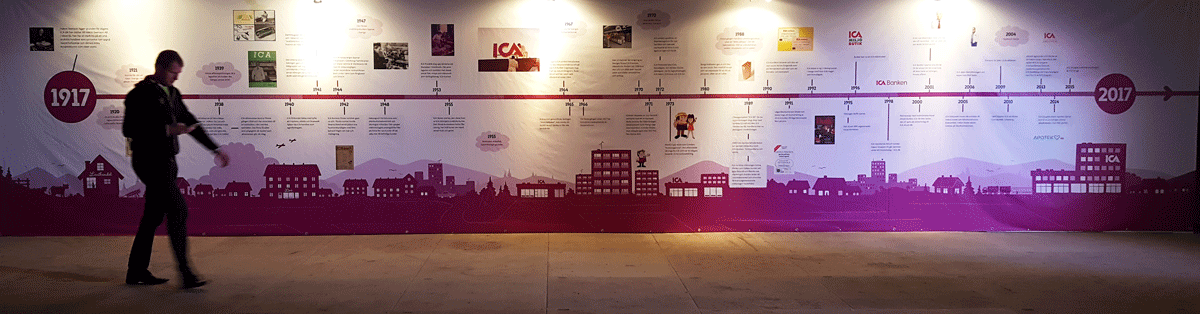
For many who sett out to tell history, a timeline is a natural starting point. A chronological list of important events quickly gives an overview of the company’s development.
There are many engaging and informative timelines, but also plenty of less successful ones. They often fall into two traps. The first is a monotonous listing in which one event follows another, without any discernment. Much like schoolchildren’s stories about their summer vacation: “First we went boating, then I saw a turtle, then Grandpa died and we buried him, then we had ice cream …”.
The second is choosing the milestones based on the company’s own organizational changes: a new CEO takes office, a company is acquired, a product is launched. To outsiders, the result can easily seem very self-absorbed.
A good timeline should therefore be guided by a clear narrative. The milestones should be selected with a purpose and themes that make them relevant also to outsiders, and they need to be told in a way that avoids a monotonous list.
In other words: by all means, create a timeline, but first put together a solid synopsis. Start by considering who the story is for and why it is being told. That will make the timeline’s milestones interesting to people beyond the innermost circle of the organization.

YOU GET ALL this if you follow the history marketing process we use at the Centre for Business History, which is described in the next chapter.
But before that, for those who are interested, a few words about daring to let researchers into the archives.
History Marketing - The History of Companies as a Strategic Asset (Business History Publishing, 2023) by Anders Sjöman.

Updated