By Susanna Lundell. First published in Företagshistoria #3, 2024.
How would you describe the Centre for Business History to someone unfamiliar with it?
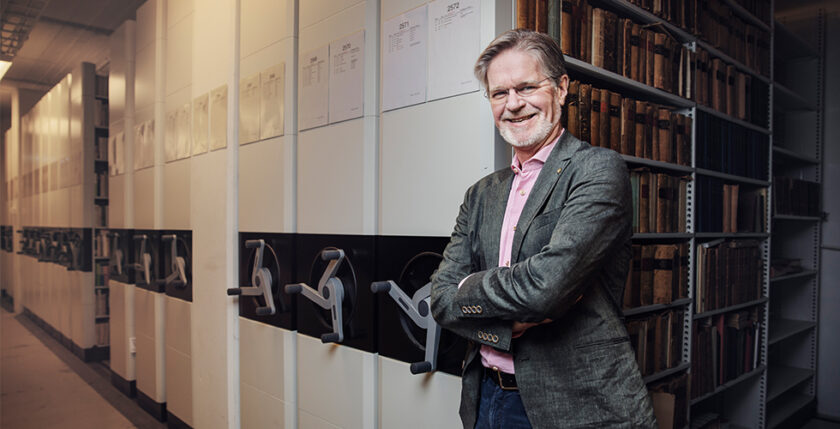
The Centre for Business History takes care of Swedish companies' historical materials for them – and after 50 years of operation, we are one of the world's largest business archives . In our depots, we host materials from the late 1600s up to the present day, with over 85,000 shelf meters of archives and up to 5 million photographs. There are also films and objects here, for example all of H&M's design collections. We currently have 28 employees, most of whom are archivists.
What is particular about our setup is that our customers are also members in the non-profit association that owns everything we do. They buy archive and storytelling services from us, but then we can also publish books and writings under our own publishing house, conduct our own research, and work with schools.
This year the Centre celebrates 50 years. Tell us about some milestones over the years?
The initiative to establish the centre was taken by the City of Stockholm and the Stockholm Chamber of Commerce in 1974. At that time, Stockholm was undergoing a major wave of demolition; among other things, the famous Klara blocks were torn down, and much of companies' historical material was about to disappear.
The Centre for Business History was created to take care of that. Over time, we then received more and more material from more and more companies, soon from the whole country. We have moved several times to accommodate the ever-growing archives from member companies.
An important milestone was the digitization of the Nobel family archives, where we collaborated with colleagues in several countries and it culminated in a book published by Bonnier about the Nobel family. Another was when we took care of the Bonnier archives, where, among other things, August Strindberg’s original manuscripts are housed.
A third milestone occurred a few years ago when the forest corporation SCA moved its archive with over 5,000 shelf meters of material from Villa Marlo outside Sundsvall to us. That meant many long trucks full of forestry history.
What role has the Centre for Business History played for research and society during these years?
Through our non-profit association, which is the main entity for the organization, we have worked since the start to have more people research the material we take care of. Since our inception 50 years ago, 76 dissertations have been written here and thousands of researchers have used the member companies' materials.
Our recurring full-day History Marketing Summit has also been important, as well as everything we do to get more companies to understand the value of active use of history, or history marketing.
You have been CEO for 27 of these years. What is your best memory from this time?
It's hard to choose, but one example is when we were commissioned by Ericsson to tell their history on a CD in connection with the company's 120th anniversary almost 30 years ago.
It sounds old-fashioned in today's online era but became the start of a completely new way to digitally tell a company's history. Another very recent memory is when we received Lars Norén’s literary estate.
What challenges have you faced during your time?
I became CEO in 1997, after we had recently undergone a reconstruction and passed through a period of financial difficulties. The task was to build up the organization on a solid foundation and it required us to get long-term commitments from our member companies.
Of course, there are challenges related to our mission to preserve and make accessible business history. Not least keeping up with technological development. How we can take advantage of digitization opportunities to make archives even more accessible for research by more people, without compromising the security requirements of that work.
Another challenge concerns finding methods to secure digitally produced material for the future, for example archiving email in the same way we previously archived paper letters.
Are there similar institutions to the Centre for Business History in other countries?
No, as far as we can see, there are no archive institutions exactly like ours, but similar ones exist here and there, often linked to chambers of commerce or university environments. Additionally, companies abroad often have their own archivists and historians employed; sometimes they even have their own museums.
If you get to look into the future, how do you think the Centre for Business History will look in 50 years?
We have a couple of challenges. One is – will we have space for everything? We hope to remain in our current premises in Bromma. Another challenge is digitization and AI. On one hand, we need to scale up companies' digital dispositions. On the other hand, we want to make it easier for researchers to conduct research.
A third challenge is reaching the new companies. Take for example the successful "unicorns" that the media have written about for several years. How will we get them to want to preserve their history? We also want to expand school activities. It is important for young people to learn what source criticism is, and we notice there is great interest.
History is not just for adults and older people, we see this when young people become completely reverent in our archives, when they get to see or hold an original document no matter how old it is, you can call it "the archive effect". The feeling of meeting the founder of a today large company gives authenticity.