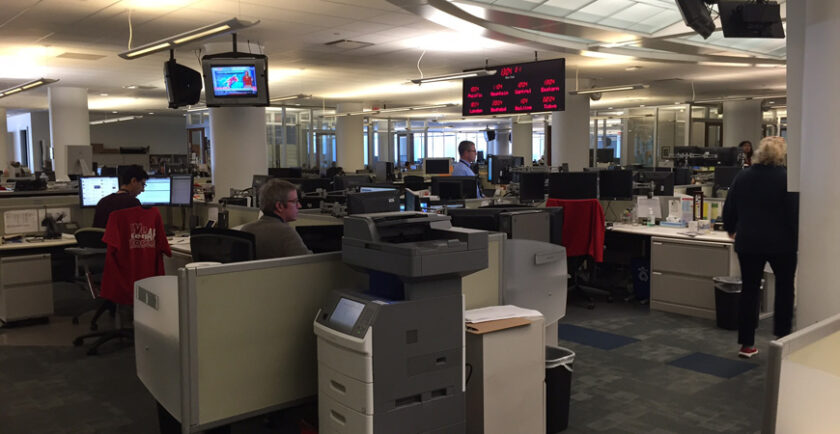
Not entirely wrong either that he also became that typically American enthusiastic about the fact that we at the Centrum för Näringslivshistoria have material from the jungles of Vietnam where Ericsson's engineers surveyed line routes in the early 1960s. The occasion was given during my visit to the Associated Press headquarters on 33rd Street in NYC.
I am used to boasting about our large photo collection but had to hold back when my friend and colleague Valerie Komor told me about AP's 16 million photographs. Strangely enough, AP is the only news agency that manages its historical archives and has therefore been able to gain an advantage over others, including Reuters, when producing documentaries and other content. Some of them can be found here.
Företagshistoria, our own magazine, is a hit wherever it appears. Now on a number of editors' desks on the 17th floor at AP. When will we get an international follow-up?
You get a bit proud when Centrum för Näringslivshistoria stands as an international model in combining non-profit activities with commercial products. In the USA, there is really only one equivalent – the Hagley Museum and Library in Wilmington which is based on the resources of the Dupont family. They run a sort of Skansen with an industrial character as well as a research center with materials they have collected and also purchased for large sums at auctions. Now they want to commercialize the operation and want more of CfN's "wisdom and experience." We are happy to provide that.
It is actually not the case that schoolchildren in the USA get a positive image of entrepreneurship and business history. If they get anything at all, it can often, surprisingly enough, have similarities with how it looked in Swedish schoolbooks a few years ago. Often the entrepreneur can be depicted as greedy and driven solely by self-interests.
Not surprising then that at the Museum of American History they compensate with a tribute to the entrepreneurs. American Enterprise is one of those presentations of American hyper-pedagogical storytelling. Dramatic against the backdrop of the world and with objects that invite visitors to fish into their own memories and nostalgia.
At Centrum för Näringslivshistoria we were visited last autumn by Radu Ioanid who talked about how the Holocaust is documented at the United States Holocaust Museum. New materials are still waiting to be discovered and a small piece of the puzzle we could help with from the Ericsson archives, where the destruction of Warsaw is documented in photographs. Now it was time to visit the museum and follow up on new ideas about material in Swedish archives. Getting through the museum's permanent exhibition is deeply affecting. The weight of all the documentation, the objects (transport carts, gravestones, cobblestone streets) makes the walk among silent spectators, many with tears in their throats. Then meeting today's horrific acts in Syria at the end makes one despair at the dance of violence and our own helplessness in the face of the refugee flows.
The week went quickly – you never get bored among colleagues in the USA!