
This text is from:
History Marketing - The History of Companies as a Strategic Asset (Business History Publishing, 2023) by Anders Sjöman.
Where we meet a hesitant marketing director who sees history and the future as each other's opposites, when in fact they both point forward! We establish what history marketing means: drawing strength from the past for what we do today. We explore the concept's roots and take a first glance at the book’s strategic toolbox.
By Anders Sjöman.
From History marketing - Using history as a corporate strategic asset (2023).

“History? That’s what they study at universities. We focus on the future.”
The marketing director at the Swedish, soon 100-year-old technology company, stared at me. He was facing the company's largest product launch in years, and I had just suggested that he use a big chunk of the launch budget on highlighting the company’s history.
“What we’re doing today is entirely new. We’re working with digitalization. What can history of old mechanics do for us today?”
I had an answer to his objection.
The company’s history was rich with precisely the kinds of successful launches he was now planning. The new product was built on the same principles and met the same needs as the original product had 100 years ago—only better, faster, and cheaper. What’s more, the company had a professionally organized archive with plenty of material to work with too.
But to the marketing director, “historical” meant outdated.
Especially when a a tech startup had just put a competing product in the market. The young company rode on the image of being innovative and hip, in tune with what modern times required.
What the startup did not have, though, was experience. The kind of cultural heritage that the century-old company had in abundance. It had experience from previous launches, but above all, it had shown how it could always challenge itself and think in new ways. Companies don’t make it to 100 without constantly reinventing themselves and re-evaluating past decisions. This company had weathered previous changes through exactly the kind of bold initiatives it was now facing. Surely customers would prefer a company with proven expertise over an untested team of still-wet-behind-the-ears-techies?
I believed the company should use all their history to drive home this business argument. Its legacy was precisely the evidence that would make customers choose
their product over the competitor’s.
But before I could explain, the marketing director hurried off. Apparently, a campaign ad needed approval.

I WORK AT the Centre for Business History in Stockholm, where we help companies preserve their historical material and use their history as a strategic asset.
Over the years, we have met many business leaders who think like the marketing director at the technology company. They may be history enthusiasts in their private lives, but when it comes to their own company, they do not see the role history can play. This attitude stings for anyone with an interest in history—but at the same time, it is not surprising. The nature of business is to look
forward, to plan for the next thing, to not rest on its laurels. Companies are rewarded for the investments they make today, not for the ones they made earlier. With their sights always set on the future, it is also easy to see everything that has happened as a drag on progress. At most, a company’s history might be dusted off when it is time to thank retiring employees.
Or you can choose to look at history from a completely different perspective.
Like the retail company Clas Ohlson.
In 1918, 23-year-old Clas Ohlson started a mail-order business in rural Insjön, Dalarna. Customers from the entire country soon ordered goods from his popular catalog. (not unlike the Sears Roebuck catalog in the USA.) In the 1990s, the company began opening physical stores and by its 100th anniversary in 2018, Clas Ohlson had 238 stores in five countries.
However, the future of brick-and-mortar stores seemed very uncertain. Like the rest of the retail industry, Clas Ohlson was being affected by digitalization, as customers wanted to shop faster and more easily—online. During its anniversary year, the company decided to close all its stores in the UK and Germany and focus solely on e-commerce in non-Nordic markets.
For a company where opening new stores had long been the measure of growth, this was a big step. And how do you use your history when the old model for success no longer works? Isn’t it best just to forget the past and look only to the future?
“No,” said Lotta Lyrå, who was CEO of Clas Ohlson from 2017 to 2021, during a talk in 2019. “That’s exactly when we should turn to our history.”
When Clas started his business, he never intended to run a mail-order company, a chain of stores, or an e-commerce operation, Lotta said. Clas' ambition was something more ambitious: to solve people’s everyday problems and make their lives easier, no matter where they lived.
A hundred years ago, mail order was the best way to do that. In the 1990s, it was stores. In fact, when the first stores opened, many people felt that the company was betraying its heritage. That wasn’t the case then, just as closing stores in 2018 didn't mean the the company abandoned its heritage.
“Now it’s our turn to step into Clas’s shoes and ask ourselves: If he were founding the company today, what would he do to realize his vision?” said Lotta Lyrå.
Those of us who believe in actively engaging with history in a way grounded in sources, of course, fully agree with Clas Ohlson’s CEO. A company that knows its history can distinguish between solutions tied to a particular time and the principles that have guided its business throughout its existence. Yesterday’s solutions rarely work today. But the story of why they came about gives us the strength and courage to make tough decisions in the present.
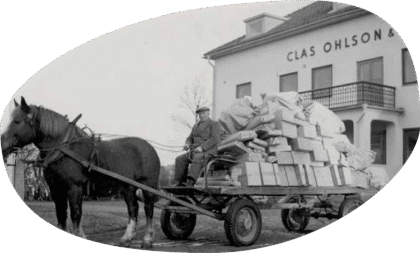

Much distinguishes driver Olof Bergkvist, who in 1943 took that day's mail-order orders to the post office in Insjön, from the “Clas Fixare” who in 2023 visits people at home. But what unites them matters more when connecting past and present: both help people solve everyday problems, using the opportunities of their time. (Images: Clas Ohlson's archives.)
The reasoning gave today’s company leadership a solid foundation for the tough decisions that had to be made about the direction of the business.
And to keep the company’s history alive, there is now a historical exhibition at the flagship store in Insjön, a podcast series with historical and contemporary comparisons, and much more. Most of this was developed in connection with the company’s 100th anniversary in 2018, but it continued beyond the anniversary year. Because a company’s history needs to be told over and over again, to keep it alive, relevant, and connected to today’s business processes.
HISTORY AND THE FUTURE are often ilustrated by a signpost whose arrows point in two opposite directions. As if business leaders always had to leave the past behind on their journey toward the future. But Clas Ohlson’s CEO took a different view, one that the technology company’s marketing director did not agree with: history and the future both point forward. This perspective makes it easier to see history as a strategic asset—one that could be valuable to all types of businesses, regardless of age, industry, or ownership structure.

The aim of this book is to show both the strategic gains companies can achieve when they see their history as an asset and the tactical advantages they can gain from using history to support their business.
Today, history marketing is an established term for when organizations actively work with their own history. At companies, active users of history are often found in the communications and marketing departments. They use history to strengthen brands and support marketing efforts. But actively using history benefits more areas than just external communications. A history that is alive and often told within an organization helps strengthen it and all its employees. History can also help companies protect intellectural property, adapt to change, and manage risk. Not bad for an asset that is created and grows simply because the business keeps moving forward!
That is why this book is intended not only for marketers and communications professionals, but also for corporate lawyers, HR managers, product developers, executive teams, CEOs, and, in short, everyone wondering how history can create value for their own organization.


Effective use of history creates a clear connection between past and present. Examples include department store NK in its subway advertising campaign in 2020, and the Dutch airline KLM during its 100th anniversary in 2020.
Long before the concept of history marketing appeared, there were of course companies that used their history.
In Sweden, Stora Enso traces its roots to 1288, making it one of the world’s oldest businesses still in operation. IKEA has built its business around Ingvar Kamprad’s founder’s history. In Ireland, the Electricity Supply Board often bases its communications on the significant contributions it has made to the country’s development at every stage.
And in the United States, Coca-Cola of course builds its current activities on foundations identified more than a hundred years ago: the secret formula, the shape of the bottle, the look of the logo, and a trademarked shade of red.

It was the German historian and communications consultant Alexander Schug who coined the term history marketing in the early 2000s for this kind of history-based communication. He also wrote the first book on the subject, History Marketing (Transcript Verlag, 2003), which we at the Centre for Business History published in a Swedish edition in 2010: History Marketing: Use the Company’s History in Communication and Marketing (Ekerlids förlag). The book you are now reading draws on these books—and builds on our accumulated experience at the Centre for Business History over nearly fifty years.
Schug’s concept emerged in a German context in the 1990s. When Germany was reunified in 1990, numerous archives on the East German side that had been closed to researchers were opened. They now had access to previously unavailable documents, which showed how German companies had acted under the Nazi regime and during World War II. In addition, in the mid-1990s, debate began over how much money Holocaust victims had in so-called “dormant accounts” in Switzerland—accounts they had opened before or during the war, and which their surviving relatives should have a right to claim. The debate quickly spread to Germany as well. At the same time, debate over compensation for forced laborers in the German war industry also gained momentum.
All this put pressure on many German companies to address their history. They were forced to examine themselves and their historical conduct. They took their historical materials and organized them in professional archives, if they did not already have them. They invited researchers to write independent academic reports clarifying what had happened. For a time, the media kept reporting on various studies of corporate responsibility, most often conducted by qualified academics.
Once that work was done, the German companies had a well-documented, verified history. And like all histories, theirs too contained, beyond the dark legacy of the Nazi years, brighter chapters worth remembering and highlighting.
Some companies began using this independently researched historical narrative in their marketing. Not long afterward, Schug introduced the concept of “history marketing.”

The word “marketing” easily brings to mind terms such as “advertising” and other forms of paid marketing communication. But the concept of “marketing” is broader than that, encompassing all the activities involved in taking a product or service from idea to implementation and ultimately to the customer. The active use of history, grounded in actual source material, has a place in every part of this process.
The term “history marketing” then took time to become established and to be defined. The definition we use today is that:
History marketing is when a business actively uses and works with its own authentic story and historical context to strengthen its brand and organization.
The definition starts from the premise that history is an asset companies should use, making “active” a key word. It is equally important to always start from what actually happened—hence the key word “authentic.” The closing words, “its historical context,” reflect the fact that every company must also relate to the broader story of society, in addition to its own history.
The definition takes the practitioner’s perspective. History marketing is a commercial, business-driving use of history, based on verifiable sources, used in a corporate or organizational setting.
In academic circles, “uses of history” is a broader concept for studying how various actors in society use history. This book takes a narrower, more instrumental approach: we look only at companies’ strategic use of history to meet business objectives and drive the company’s future development. Our research director Anders Houltz explains more about academia’s view of the use of history here.

With an instrumental view of history, there is of course a temptation to abandon serious, fact-based historical writing and simply “write some good history,” disconnected from historical sources and from what actually happened (or not).
So let me make it clear right away that the history marketing we advocate must always be based on verified sources and confirmed events. We will develop this line of reasoning later on, but it is important to keep in mind from the outset.
In many circles that use history, the term “heritage” is often used in parallel with “history.” This explains why the concept “heritage management” has also become common. It is typically used to describe work that organizations do when preserving, caring for, and promoting their historical heritage – in other words, it is very similar to our concept of history marketing. If this book had originated in an academic context, it is quite possible that we would have called it
Heritage Marketing instead of History Marketing. The two concepts are that closely related.
However, we stick to the term history marketing, as we believe it more clearly relates to the benefits that companies derive from using their history, and because the related term heritage management is also used by many cultural heritage institutions, such as UNESCO’s “world heritage sites.”
A LOT HAS HAPPENED in the field history marketing since the Centre for Business History published Schug’s book in Swedish in 2010. Today, more and more businesses actively use their history in thoughtful ways that drive business. Many of them hire experts to manage their historical documents in professionally maintained company archives, so that their history is always “close at hand.” It's encouraging that the role that history can play in day-to-day business has become clearer at many companies.
This book reflects that development as it reviews fundamental perspectives and methods for history marketing. It can be seen as a handbook or methodology guide to the strategic use of history, and it is structured around four chapters:
CHAPTER 1 discusses the general role that history plays in our lives, both personal and professional, and reflects on how companies view their own history.
CHAPTER 2 examines what makes history a strategic asset that companies and organizations can use to drive business through the use of history.
CHAPTER 3 discusses important choices that all users of history face, from how they can gather their historical material to how they can handle less flattering aspects of their history.
CHAPTER 4, finally, goes through how history marketing is put into practice in companies. It presents the process that we use at the Centre for Business History to help companies use their history to drive business.
Let’s get started. Head on over to Chapter 1.
History Marketing - The History of Companies as a Strategic Asset (Business History Publishing, 2023) by Anders Sjöman.

Updated