
This text is from:
History Marketing - The History of Companies as a Strategic Asset (Business History Publishing, 2023) by Anders Sjöman.
Where we describe the process for history marketing that we’ve refined over the years and that strikes the right balance between then and now. It builds on three guidelines, one Heritage Statement and three process steps.
By Anders Sjöman.
From History marketing - Using history as a corporate strategic asset (2023).

SINCE 1974, WE at the Centre for Business History have preserved Swedish companies’ historical materials for them and also helped them research and tell their stories.
We have evolved as they have kept on asking challenging questions and continually sought new ways to tell their stories. Because a company’s history can be presented in many ways. We have produced anniversary books, popular history magazines, history websites, films, podcasts, monographs, exhibitions, theater productions, installations, lecture series, company museums, and much more. We haven’t yet produced a corporate opera or interpretive ballet, but I assure that’s not for lack of trying.
Over the years, we have developed a process for using history effectively. It is, of course, based on lessons learned from our stumbles—for example, producing books so massive they were barely possible to leaf through, or failing to place a company’s development in a broader social context. But we have learned, and have only gotten better at creating company histories that engage a broad audience, are factual and accurate, and are easy to tell in many different formats.
The process we have developed is based on three guidelines, a heritage statement, and three process steps. Let's take them in that order.
Companies quite often say that their company history must not be “too focused on the past.” History should not preserve the status quo (remember the discussion of path dependence), but “we also have to talk about what we’re doing today.” Although “too focused on the past” feels a little out of place when describing a historical narrative, we understand what they mean: history should lend strength to future ambitions.
The key, then, is to find a balance where the stories of before point forward, toward the company’s present and its future challenges and opportunities. At the same time, we must not describe the past as though today’s developments were the only possible outcome—the kind of backward-looking company history we discussed earlier.
Our history marketing-process therefore starts with three guidelines that we have refined over the years.

Why does a company tell its story? Quite simply, to build its brand, both externally and internally. The strongest support for the outside world’s belief in the company’s ambitions today is everything it has actually done in the past.
We often say that history is the company’s evidence for today’s promises. Not literally, of course. But a well-documented and well-told history makes it more reasonable to believe that the company can live up to its ambitions once again. It strengthens customers’ confidence and employees’ faith in the company.
History also gives today’s employees extra strength in facing today’s challenges: those who came before showed that great things can be achieved.
It’s quite easy to write a bad history book: just string together a bunch of anecdotes from the past. They’re fun for the moment, but quickly go in one ear and out the other. They also often become overly nostalgic, where each story becomes a sigh of longing for how the storyteller thinks it was in olden times.
To avoid the anecdote trap, stories must be connected to today’s business. A good company history is full of telling stories, that reflect, contrast with, or deepen our understanding of today’s situation.
A business-driven use of history therefore builds on the company being able to articulate where it is today and where is is heading. Its historical narrative should then focus on those roots that actually relate to today’s ambitions. Think of it this way: Start with the future and work back.
The phrase is not ours, nor is the approach. It was coined by Bruce Weindruch, founder of the American heritage company The History Factory. His book Start With the Future and Work Back: A Heritage Management Manifesto (2016) is essential reading for anyone using history.
With the “future first” approach, history is connected both to the present and to what lies ahead. It also sharpens the questions of why history is being told and for whom. Should it help the company recruit, establish itself in new markets, or prepare the business for change? Are we telling our stories to employees, customers, suppliers, partners, or politicians? There may be many target groups and purposes. But the more clearly they are articulated, the easier it is to find the historical threads that relate most to today’s situation.
A sure way to make a company history dull is to simply describe the organization’s development: first we were founded, then we acquired a company, our CEO was named John, and then this happened …
The company’s own development is important baseline information, but rarely a compelling story in itself. Effective use of history instead focuses on what the business has contributed, not what it has done. The stories should primarily be about why the company did something, not how they did it. The company’s own development will still be included, but the story becomes more interesting when it starts from the needs that the company actually met.
A good company history should therefore support today’s promises and provide strength in the face of tomorrow’s challenges, not just retell “how things used to be.” So we start with the future and work backward. And to create an engaging narrative, we focus on what the organization has contributed to society rather than on its own development.
On top of that, there is of course the question that all communicators always ask themselves, and which also applies to history marketing: Who are we communicating with and why?
With this in mind, we recommend that companies formulate what we (rather ambitiously) call a heritage statement. It always begins the same way, but ends with wording specific to the organization in question:
The story of company X
is really the story of …
The conclusion should capture the perspective that makes the company’s history interesting to a wider audience, both internally and externally, and gives it dramatic tension. In short, it should bring together the ambitions of the three guiding principles.
I realize how abstract this sounds. Let me give a few examples.
We return to the retail company Clas Ohlson. The company history could easily focus on its founder Clas (1895–1979) or on the structure of the mail-order company that started in Insjön in 1918 and expanded across the country. Both perspectives are important, but ahead of the centenary in 2018, we chose a different starting point together with the company:
The story of Clas Ohlson is the story of
helping people solve their everyday problems for over 100 years.
After all, that was the founder’s main idea: how could people in rural areas gain access to all the useful gadgets and tools available in big cities that made everyday life easier? Based on this guiding statement, a company history was then developed that focused on precisely this, while also, so to speak, naturally telling the story of Clas himself and the development of the business.

Another example is film company SF Studios, which celebrated its 100th anniversary in 2019. The company has a rich history dating back to the first golden age of Swedish cinema during the silent film era. Back then, it was called Svensk Filmindustri, had its own Hollywood-style studio lot just outside Stockholm, and employed scores of full-time staff in front of and behind the camera. During the silent film era, it even had its own symphony orchestra. The revenue was stable, coming from movie theaters which were the only way to watch films.
Today, the film industry looks completely different. The company’s own studio are gone; instead, production teams are made of freelancers for each project, or the company co-produces films with other production companies. SF Studios was certainly still making films when it turned 100, but what purpose would there be in talking about the studio in Råsunda and the big box-office revenues when that era had long since passed?
Together, we found a common thread though that ran through the entire century: great talents had always gravitated toward SF Studios. Mauritz Stiller, Greta Garbo, and Ingrid Bergman began their careers there, and Ingmar Bergman developed there into a world-renowned director. It was at SF that Lasse Hallström made My Life as a Dog, not to mention all the adaptations of Astrid Lindgren’s children’s books.
The common thread was summed up in the heritage statement:
The story of SF Studios is the story of
Swedish film talent over 100 years.
From The Phantom Carriage to A Man Called Ove,
talent has always been drawn to SF Studios
In this way, history took on a business-driving role. By highlighting all the stars who had chosen SF Studios over the years, the aim was to attract today’s filmmakers. How the films were actually produced became secondary.
The history was presented on a website, showcasing 30 of the company’s most important productions over 100 years, along with the people behind the films. The idea was to present a powerful film-historical context that today’s filmmakers would want to be part of.

A third example comes from Swedish pension company Alecta, which manages the occupational pensions of 2.6 million private individuals (a considerable number in a country of 10 million) and 35,000 companies. It has done so since 1917, initially under the name SPP. At the time, white-collar employees and employers agreed to create what was called an "untouchable pension": a pension that stayed with the employee when they changed jobs. Common-place today, but almost revolutionary in the early 1900s. This helped create a more secure and flexible labor market, because people who feel secure are more willing to take a chance on new jobs and employers.
Alecta’s history contains further groundbreaking steps taken in cooperation between the social partners. The heritage statement therefore became:
The story of Alecta is
the story
of coming together
to build shared security –
giving us all a safer society.

Once the heritage statement has been established, it is usually also a good idea to define a few subthemes. This will make it easier later to identify which historical threads are most relevant. For SF Studios, for example, three subthemes were established: “Talent,” “Productions,” and “Business Development.” For Alecta, they were “Customers and Pensions” (being able to live securely throughout one’s life), “Employees Who Got the Job Done” (constantly advancing society’s solutions for security), and “Asset Management” (the actual management of pension assets worth billions).
The idea behind having subthemes is that all the stories developed in line with the heritage statement should relate to one or more of these themes. Stories that do not connect to any theme are excluded.
The heritage statement and its underlying themes should, of course, also be formulated with the intended audience in mind. Why is the story being told to these particular people, and what is the purpose of telling it to them? This is the history user’s version of the most classic question in communications: who are we talking to, and what are we trying to influence them to do? There are many communications and marketing books that address how to answer this question, so I will not go into it in greater depth here. One should simply not assume that the question is any less important for a good company history; on the contrary, it is fundamental to all uses of history.
With the heritage statement and subthemes in place, the foundation is set for the practical history marketing-work. We usually divide this part of the process into three steps, although every company has its own circumstances and its own history. Each company’s history marketing should be tailored to its specific circumstances and the process steps can always be adjusted. That being said, we have learned that these three steps are a good starting point when it comes time to put words, images, and sound to a company’s history and heritage.
To select the most relevant stories, it is of course necessary to have an overview of all the potential stories. (We will return to what makes some stories more relevant than others in step 2 below.) Every business simply needs to get a thorough understanding of its own history.
This is where the archive comes in, if there is one. You review what has happened and list the events. If there is no organized archive, it is still possible to create a historical overview, although it takes a little longer and requires searches in more places. So it is possible to produce an authentic, fact-based company history even without a company archive of one’s own.
At the Centre for Business History, we usually build the overview as a history timeline. We enter events from the company’s entire lifespan, briefly and along a timeline. For ease of reference, the milestones are grouped according to the themes that were hopefully developed from the guiding statement.
The history timeline should include everything from the major to the minor. The aim is to find many stories and also be able to substantiate everything them all. Events drawn from archival records are verified by default, so to say. Information from previous anniversary books and monographs can also be included, but should be flagged for further verification. The same applies to stories from in-depth interviews with managers, employees, or former employees.
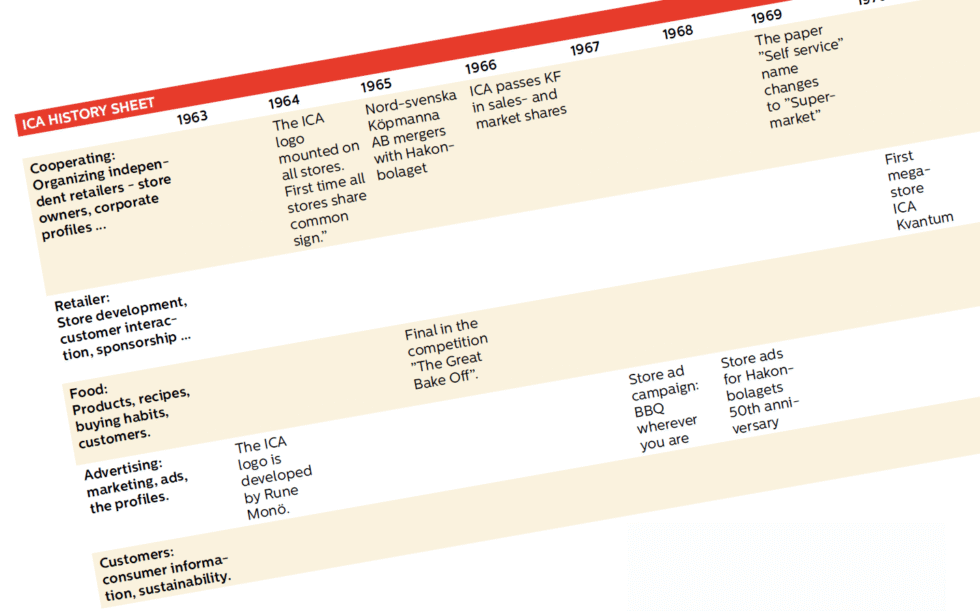
One such company history sheet was used ahead of Clas Ohlson’s 100th anniversary. The overarching story was about the things that have solved our everyday problems, with three subthemes: the products, as they have appeared in the catalogs over the years; the people, above all the customers who have been helped, but also those who came up with the ideas; and the organization, its roots in Insjön and its growth from there. All the important events and stages of development were written under these themes. When the work was complete, the company’s history had been gathered in brief in one place. (The image above shows a similar company history sheet prepared for ICA’s 100th anniversary.)
A company history sheet can, of course, always be supplemented with more facts and details. But most projects reach a point where they are complete enough: the company’s history is now gathered in an overview—a comprehensive list of stories, sorted by theme. Which ones are best to use? We’ll address that in step two.
AFTER STEP ONE, YOU HAVE: A company history overview, perhaps in the form of a history sheet, with the organization’s events, turning points, and developments arranged by theme. The events are described mainly as headings, except for the most important ones, which are described in greater detail. Links to relevant archival material, such as photographs and documents, are provided where available.
With a multitude of potential sotires now laid out, the history marketer can start selecting which stories from the past that best capture the perspective outlined in the heritage statement. It is a selection process that has to done: a history can never contain all of a company's stories, there just isn't room or time enough. The selection must be limited to the most telling stories, those that can truly carry the themes from step one.
To help us make that selection, we can turn to one of the literary giants of the early 20th century: Virginia Woolf. She wrote a classic essay on the art of writing a biography, which is inspiring even when the subject is a company history. In The Art of Biography, published posthumously in the essay collection The Death of the Moth and Other Essays (1942), she writes:
“But almost any biographer, if he respects facts, can give us much more than another fact to add to our collection. He can give us the creative fact; the fertile fact; the fact that suggests and engenders.”
The fertile fact. That is what we are looking for as we sift through the stories in our history sheet. We want to find facts and stories that are so fertile they take on greater symbolic value: they should be compelling in themselves while also saying something bigger about the company, based on the guiding statement and the chosen themes.

Playwrights have always worked according to this principle. In a specific event, they seek to capture something universal. Because in the particular is contained the universal (said James
Joyce), in one drop of water are found all the secrets of the ocean (said Kahlil Gibran), and one can see a world in a grain of sand (according to William Blake).
So how can you recognize a "fertile fact"? This is where the heritage statement with its supporting themes come into play. When stories are tested against them, it often becomes clear which ones carry the larger company history and which can be discarded. A skilled storyteller quickly learns to recognize a story that carries weight among all the facts.
For example, it is a fact that in 1964 ICA got a unified logo for all its stores for the first time, and that it is the same logo the company still uses today. But beyond that event description is a fertile fact about ICA’s development. ICA had for a long time attempted to create economies of scale despite each affiliated shop being run by its own entrepreneur and under its own individual name. It was only in the mid-1960s that all retailers finally agreed to use the same name and have a unified logo. Putting the ICA-logo on top of every shop was the first step towards a truly nationwide network. A few years later, ICA overtook competitor Konsum in market share. A photograph of two men installing an ICA logo on a store in 1964 encapsulates the entire story of a decision that reshaped the Swedish food retail landscape. It also serves as a reminder to all of ICA’s retailers today that they always need to seek collaborative solutions that benefit the entire organization.

An old gray binder can also be a fertile fact. Ericsson’s historical archives contain one of the lever-arch binders that stood in offices everywhere in the 1970s. It looks unremarkable, but contains the consolidated project plan for developing the revolutionary AXE system. AXE was the digital telephone switching system that took Ericsson from a “third-rate telecom company,” as some media outlets described it, to a global industry leader. At the time, the telecom world was dominated by relay-based switches built from sheet metal and copper wire. Ericsson already had an almost-finished relay system, AKE, ready to launch. Even so, the company chose to invest in AXE—a system that was not yet complete, required higher development costs, and was based on unfamiliar digital and electronic technology.
The result was the world’s first fully computerized telephone exchange and the foundation for Ericsson’s growth over several decades. With hindsight, knowing how digital the world became, the investment may seem obvious. But when the decision was made, it was far from obvious.
So if the fact is that the AXE exchange was built, and the binder is its physical embodiment, then the fertile fact is that without that investment, Ericsson could have gone under. Hopefully, it will give today’s Ericsson employees the courage to question previous technology choices and take new, bold leaps. A grey binder then becomes something worth remembering every day on the way to work.

These are the kinds of stories the user of history looks for at this stage: those that connect with the guiding statement and themes. They may be about perseverance, founding ideals, craftsmanship and traditions, ties to places and communities, innovations, contributions to society, pioneering achievements, iconic products and services, or the founder and founding family.
They may also be about failures, misguided ventures, and setbacks. Such stories are often more instructive than success stories and also provide a much-needed contrast to an otherwise sanitized history. They, too, can be told in a way that fits the guiding statement and themes.
When making selections, it is also important to remember that some stories simply have to be included for the company history to be authentic and fact-based. Credibility suffers if you omit difficult but well-known parts of the story—the ones we discussed in Chapter 3.
AFTER STEP TWO, YOU HAVE: A selection of stories that are the most significant and fertile for the company’s larger history, and that all connect to the themes established in step one. Each story often has a detailed textual description and a set of pictures, if available. In other words, the stories are in a detailed manuscript form, ready to be packaged appropriately.
“Hi, we’re celebrating an anniversary and want to make a coffe-table book about our history.” That’s how many calls to us begin.
Companies often start with a set format (a book) and a calendar-based reason (an anniversary) when they set out to tell their history. We often suggest pausing the idea of a book production, and instead think about the what and why before the how. In short, we recommend they follow our 1-2-3-step process for effective history marketing.
And in that process, packaging is the third and last step. Only once we know what direction the history should take and have written the stories that support it can we decide how best to tell it. The format is also chosen based on who will engage with the history and in what setting.
We’ve probably discussed how to shape the story, or the “deliverable,” as agency people sometimes call it, several times over the course of the work. Perhaps there’s already a working hypothesis. If not, this is when we start batting around ideas: should it be a book, magazine, short films, film series, branded merchandise, permanent - or pop-up - exhibitions, theatrical installations, a historical website, interactive timeline, or digital mashup with maps, timelines, images, and text. Perhaps an Instagram #tbt series, social media stories, or a podcast series would work better.
(By the way, our most successful podcast delivery? It might be the one about Atlas Copco’s history, which the company played over the speakers in the restrooms during an annual general meeting. People stayed longer than they had really reason to.)
Of course, the process may result in exactly the book the company had in mind from the start. The original format may still suit the heritage statement, target audiences, and selected stories. But just as often, it leads to a different solution. That was the case, for example, with a large Swedish trade association. They originally envisioned a weighty coffee-table book to tell their century-long history. But together, we concluded that the organization’s history needed to reach all individual members, not just the member companies where they worked. The vision therefore changed from an impressive coffee-table book on an office desk to a well-thumbed magazine on every member’s bedside table.
Waiting until late in the process to package the material also makes it possible to tell the story in several different ways. “One history, many ways of telling it,” as we like to say.
ICA’s company history, which we developed for the 100th anniversary in 2017, was packaged in four magazines sent out quarterly to all ICA retailers. The same material was also published on the in-depth history website ica-historien.se - and became the script for a 15-minute film. The film used images from the magazines and video material that was also available on the website.
All the formats were based on the same selected stories and themes, but were adapted to their respective medium.
We also took the opportunity to make use of each medium’s specific capabilities. The website, for example, features digitized source material directly from ICA’s corporate archives, searchable by anyone who wants to check the sources for themselves.

The appliance giant Electrolux, which turned 100 in 2019, also told its story in many ways. Together, we first formulated the guiding statement:
“The history of Electrolux is
the history of the development toward a sustainable home,
for one’s own family and the surrounding community.”
Three subthemes were also defined: taste, care and well-being.
Electrolux’s history is full of drama, acquisitions, and ventures far beyond its core business. It also features strong personalities, from founder Axel Wenner-Gren to industrialist Hans Werthén and his “leadership troika.” But we did not want the story to focus primarily on executives or on how they built a corporate group. Instead, the guiding statement and themes directed attention to the value the company had created for customers in the three areas.
A history sheet was filled with events under each theme. From there, we selected the stories that could best bring the themes to life, wrote them in longer form, and illustrated them. At the same time, business journalist Ronald Fagerfjäll was commissioned to write a standalone company history book: Shape living for the better – Electrolux first 100 years.
The material then became a permanent historical exhibition at the headquarters, a history section on the corporate website, and a short film. The book was published in new versions, both in a shortened version and as an audiobook. Visitors to the office exhibition could therefore recognize the stories from the history website, audiobook, or other formats.
Electrolux’s communications staff also reused many images and captions from the website on Instagram and LinkedIn. During the anniversary year, they published three LinkedIn posts every week: one about the company as a whole, one about a historical product launch, and one about a modern product in the same category as the historical example.
Once again: one history, many ways of telling it.

How to write and produce a book, develop a film script and produce a film, plan the information design for a history website, and collaborate with a web agency... yes, all that creative production work could fill books of its own. Fortunately, many such books already exist, as do skilled creatives to do the actual work. I therefore leave production outside the scope of this book. Ultimately, it is usually a matter of which skills are available within the company and which need to be brought in from outside.
AFTER STEP THREE, YOU HAVE: A historical narrative, packaged in the way that best suits the recipient—or in several ways to reach different audiences. It is also designed to be reused later. One history, many ways to tell it.
That was our process for effective history marketing. It started with three
guiding principles, which led to a heritage statement with underlying
themes. We used that statement as a guidepost for a three-step production
process, which involved (1) creating a historical overview, (2) identifying
the truly compelling and fertile stories, and (3) packaging
them in the best possible way.
So what does it look like when the entire process comes together in a real project? As a case, let’s look at how Swedbank celebrated the 200th anniversary of the savings bank idea in 2020.
Today, Swedbank is one of Sweden’s four "universal banks", but it has only had that name since 2006. Before that, the bank was called Föreningssparbanken, a name created in 1997 through mergers. Its roots, however, go all the way back to 1820, when the first savings bank was founded. This origin led Swedbank to consider highlighting 200
years of savings bank heritage, as they approched the year 2020.
When Gothenburg Savings Bank opened in 1820, it was not only the country’s first savings bank, but also the first bank for ordinary people. In Sweden of the time, a poor agrarian country on the outskirts of Europe, this was revolutionary. People could deposit even small amounts, earn interest, and borrow money when they needed it. New savings banks were formed across the country, and they came to play a leading role in financing both households and emerging cities.
For a period, Sweden had almost 500 independent savings banks, but over the course of the 20th century, nearly all of them gradually merged with one another. Swedbank is the result of all these mergers. Today, alongside Swedbank, with its savings bank roots, there are just under 60 savings banks operating in their local communities.
Over the same time period, commercial banks such as SEB, Handelsbanken, and Nordea have emerged. They, like Swedbank, are today "universal banks" serving households, businesses, institutions, and public-sector organizations alike. But Swedbank still sees the savings bank idea as guiding its decisions and actions—an idea that it believes sets the bank apart from other banking groups.
That is why, ahead of the anniversary year, management decided to celebrate 200 years by focusing on the savings bank idea rather than on the bank itself. The anniversary would highlight the importance of savings banks to the country’s development over two centuries.
With this as its starting point, Swedbank then worked with us at the Centre for Business History, following our process. We began shortly after the summer of 2019, six months before the anniversary year, by formulating the guiding statement:
The history of Swedbank is the story of promoting a sound and sustainable economy—for the many people and businesses
The focus was thus on what today's savings banks and Swedbank have sought to contribute over two centuries, but not on exactly how they did so or in what corporate structure (local savings banks and agricultural credit associations, or through mergers such as Första Sparbanken, Föreningsbanken, FöreningsSparbanken and finally Swedbank).
We also formulated three themes: education, social engagement, and sustainable banking services for the many. The key target audiences for the anniversary story were considered to be employees and customers, followed by external partners and other stakeholders.
With the direction set, we created a historical
overview in the form of a history sheet. In reality it was a glorified
spreadsheet – but it listed all possible events and developmental stages in
the history of the savings bank world, grouped by the three themes.
We then selected from the overview the stories that best symbolized the savings bank idea, the guiding statement, or one of the themes. We also made sure to include stories about times when the bank had not been at its best. As we have already discussed, this is a good general guideline, but it was especially important for Swedbank at the time, since the bank had featured heavily in media about money laundering in the Baltics. The company history must not be whitewashed.

Swedbank also wanted the company history to be usable in many ways: in short and long formats, in print and digitally, on the web, at physical meeting places, and on social media.
Out of the research and discussions, a storytelling structure emerged. It built on having a limited number of milestone years, spread out
over 200 years, each highlighting an important event or development step –
which also reflected something that was key to Swedbank’s operations today.
After a little more brainstorming and revision, we settled on eight milestone years:
| Year | Event | ... which is really about: |
| 1820 | The founding | The savings bank idea |
| 1904 | The homeownership movement | Housing and community development |
| 1915 | The Agricultural Credit Association | Business customers |
| 1926 | The school magazine Lyckoslanten | Public education, promoting saving |
| 1967 | First stock savings plan, Sparinvest | Equity funds, modern forms of saving |
| 1977 | Sweden's first ATM, Minuten | Accessibility and technological development |
| 1995 | Stock market listing | The modern development of the savings bank movement |
| 2006 | Name change | Today's Swedbank, today's banking world |
With the research complete and the narrative structure in place, production could begin.
To give the process focus, it was decided to create a flagship product that could then serve as the foundation for all other outputs and formats: a 72-page magazine, written in a popular-history style and richly illustrated.
The magazine was named TWO HUNDRED – Money and Life Through 200 Years and built around the eight dates. Each date was covered in three spreads: one on what the country looked like at the time, one on what the savings banks did at the time (the selected milestones from the table above), and one in which someone from today’s Swedbank reflected on the theme. This kept the present constantly in view throughout the story.
The magazine was completed after the summer of 2020 in Swedish and English versions, and sent to Swedbank’s 9,000 employees in Sweden and the three Baltic states.
Drawing on the magazine’s structure, texts, and images, as well as all the research involved in the work, the material was then used in several ways, all under the concept name “Forward Then, Forward Now,” a campaign theme that Swedbank developed together with its advertising agency Forsman & Bodenfors.

On behalf of the bank, we produced, among other things, a six-episode podcast series, built around the same years as the magazine. In each episode, a company historian described the historical developments, after which guests from present-day Swedbank commented on how the bank addresses that particular theme in its current operations.

The magazine’s texts and images were also published in a new history section at swedbank.se/historia and on an anniversary website, swedbank.se/200, which was available for the year.
In addition, a five-minute internal short film was produced. In it, a young bank employee explained over dinner to her boyfriend’s skeptical parents what Swedbank and the savings banks had done over 160 years. The examples naturally followed the same chronological structure as the magazine - in other words, the milestone table above.
Some film clips were also used in an external advertising campaign on TV, in cinemas, and online. Four 30-second films told the story of how Swedbank has worked in the past and works today with children’s savings, savings solutions, public education, and business loans. The stories ranged from savings-box collectors who cycled around to today’s banking apps, from Lyckoslanten to school visits, and from the first loans to farmers to today’s business loans.

Together with the Swedish Museum of Economy in Stockholm, a six-part film series, with each episode ten minutes long, was also produced: The Savings Bank Idea, Since 1820. Each episode focused on a year and a theme from the main story and was filmed at historically relevant locations. For example, the episode about business customers opens outside the house where the first agricultural savings bank was established, in the Tungelsta area south of Stockholm.

The material was also used in internal quizzes on the intranet, history lectures at conferences, and social media posts. An Instagram post about how the oak-shaped logo of the savings banks and Swedbank had evolved over time was seen by 40,000 people.
It is worth remembering that almost the entire anniversary year unfolded in the shadow of the coronavirus pandemic. When the pandemic swept across the world in March 2020, the in-person anniversary activities Swedbank had planned for its employees became impossible. This made the magazine and the other historical formats even more important in creating a sense of celebration.

As mentioned, Swedbank had during 2019 and 2020 frequently been featured in media related to a money-laundering scandal in the Baltics. Swedbank had by early 2020 acknowledged misconduct in the Baltics and accepted the fines that had been imposed by financial supervisory authorities. The historical narrative, in its various forms, helped remind both the organization and society at large that the recent events in the Baltics were not typical of a bank guided by the savings bank idea. They were rather missteps from the road the bank normally traveled upon. And what better way to show what that road really was, than through a factually verified narrated history that was made as accessible and educational as possible?
Swedbank’s internal evaluations after the anniversary showed that employees had followed, read and appreciated the activities. Many, of course, missed the physical festivities that had been cancelled. But one comment summed up the situation: “Glad we celebrated after all, despite the money laundering and COVID.” Other comments about the magazine included “Stylish!”, “Fantastic!”, “History and the present in an accessible format” and “Great to have our history in the magazine.”
The effort also gained attention outside the bank: Swedbank won the 2021 Stora Kommunikationspriset (Big Communication Award) from the industry organization Sveriges Kommunikatörer (Communicators of Sweden). The bank won in the category of Best Internal Communication for having “chosen to build internal communication based on its history in a time of change.”
How was the company history campaign received by customers? In brand surveys after the anniversary campaign, the bank reached levels of trust it had not seen since 2019. Brand attribution—how many people remembered afterward which company the ad came from—was also the highest in many years.
Johan Eriksson, then Swedbank’s head of communications and responsible for the anniversary activities, summed up the results: “It was one of our most successful campaigns ever, across all the effects we measure. It also had a positive impact on sales.”
That is, of course, the best endorsement a campaign built on the active use of history can receive.
A company like Sswedbank, which has followed the entire process for effective history marketing is surely by then done with its history work, right? It has told its history, can check of the “history use”-box and consider the history established once and for all.
No. Absolutely not. History marketing can never stop. The history must be kept alive, both within the organization and beyond it. If you stop telling it, soon no one will remember it. In addition, new employees, customers, and stakeholders are constantly joining who also need to hear the company’s history.
Eibhlin Colgan, head of archives at brewing giant Guinness in Dublin, described the mission in 2017 like this:
“My role is to curate the history here and now, and to ensure that the people of generations to come still have access to a clearly present history, one that is a living, vibrant part of the brand.”
Constant, low-key use of history should therefore be a matter of course for every company.
There are many ways to do this. Weave the history into onboarding for new employees, publish “did you know?” facts on the intranet, or share what happened at the company on this date in customer newsletters. Put historical facts on products and in brands—some clothing companies, for example, print historical details on care labels. Give history a physical presence by naming conference rooms after historical figures or important events. Use it for anniversaries, launches, and collaborations, or in temporary and permanent exhibitions.
Or why not weave history in when a customer completes an online purchase or at the physical point of sale? A retro product at the point of sale, for example. For a while, the family-owned car dealership Atteviks in Jönköping in southern Sweden placed a magazine about the company’s history in the passenger seat of every car sold, so buyers would remember who had sold them the car.
In the end, only imagination sets the limits on where history can continue to be used in day-to-day operations.

Active businesses must also remember that new history is created every day. What happens now must also be preserved—preferably in an organized company archive—and soon begin to be told. The modern part of the company’s history also needs to be kept alive.
An activity that is to be carried out every year also needs a recurring budget. Ongoing use of history must have resources, year after year. But whoever receives a budget needs to be able to show what the money has achieved. Those who have made the resources available want at least some indication that the effort was worth the cost. What has the company gained from its archive, its history website, or perhaps its employed chief storyteller and archivist?
Earlier in the book, we reviewed more general methods for assigning economic value to a company’s history. Measuring the financial outcome of individual history-using initiatives is more difficult. As with other communications activities and support functions, it is tricky to calculate the return on investment (ROI).
Our suggestion is to develop a number of metrics (or key performance indicators, KPIs) that are easy to track. The metrics you choose depend on the organization and the focus of its use of history, but examples might include tracking how many new employees have been told the company’s history during their orientation week, know when the company was founded, can describe the firm’s most important development milestones, include a history section in their sales presentations, and read history posts on the intranet.
Externally, history-related questions can be included in customer and partner surveys that the company already conducts.
Swedbank did just that during its 200th anniversary. As we have seen, its use of history encompassed many external activities, including an advertising campaign on television, online, and in print under the theme “Forward then, forward now.” The bank included questions about history in its regular campaign surveys and was able to compare the history campaign with the other campaigns that year. The history campaign achieved the year’s highest scores for sender recognition and liking. That is a good KPI to take into the next budget process.
As the example shows, historical KPIs are like most metrics: what matters is not the exact value in each measurement, but the trend over time. Do more or fewer people know the company’s history than at the previous measurement? That is the simple underlying question.

THIS HANDBOOK ON history marketing is nearing its end.
CHAPTER 1 discussed in general terms the role history plays in our professional lives.
CHAPTER 2 then established what makes history a strategically important asset for companies and organizations, and showed three tactical uses of history marketing.
CHAPTER 3 highlighted a number of important choices that users of history need to make.
And this CHAPTER 4 reviewed the practical process of implementing history marketing in companies.
Hopefully, we have now gathered enough arguments and tools to convince the marketing director at the nearly 100-year-old technology company from the book’s introduction to draw on the company’s rich history when launching its new product.
Because he could not ask for a better resource to propel the company into the future.

History Marketing - The History of Companies as a Strategic Asset (Business History Publishing, 2023) by Anders Sjöman.

Updated